

How CETAP Used Behavioural Science to Understand Recycling in Bosnia and Herzegovina
Understanding Behaviour Before Changing It
Before asking citizens to change how they manage waste, CETAP took a step back to understand a more fundamental question:
Why do people recycle—or not recycle—in the first place?
To answer this, CETAP conducted a nationwide behavioural survey using the COM-B model, a globally recognised framework for understanding behaviour.
What is COM-B?
COM-B is a behavioural science model that explains that behaviour (B) is driven by three key factors:
- Capability – Do people have the knowledge and skills to perform the behaviour?
- Opportunity – Does the environment enable or support the behaviour?
- Motivation – Do people want or intend to perform the behaviour?
For behaviour to change, all three must be present.
CETAP structured its survey around these components, asking:
- Five quantitative questions per category
- One qualitative question to capture deeper insights
This approach ensured both measurable data and real human perspectives. The survey gathered responses from across the Federation of Bosnia and Herzegovina, Republika Srpska and Brčko District. Providing a comprehensive picture of recycling behaviours across the country.
What the Research Revealed
- Capability: A Knowledge Gap
The findings showed that many citizens are uncertain about how to recycle correctly.
While awareness of recycling exists, practical understanding is limited. Respondents frequently expressed confusion about:
- Waste separation rules
- Which materials are recyclable
- What happens to waste after collection
This highlights a clear need for simple, consistent, and visible public education.
- Opportunity: System Barriers
Even when people are willing to recycle, they are often constrained by their environment.
The survey revealed:
- Limited access to recycling infrastructure
- Inconsistent availability of containers
- Perceived inconvenience
Additionally, some respondents expressed low trust in the system, questioning whether separated waste is ultimately recycled.
This demonstrates that infrastructure and system visibility are critical to behaviour change.
- Motivation: Positive but Not Habitual
Encouragingly, most respondents recognise the importance of recycling and express a willingness to participate.
However:
- Recycling is not yet embedded as a daily habit
- It is often seen as secondary or optional
- Convenience strongly influences behaviour
This suggests that while motivation exists, it requires reinforcement through ease, visibility, and normalisation.
What This Means for Behaviour Change
The key takeaway from the survey is clear: Citizens in Bosnia and Herzegovina are willing to recycle but they feel unsupported in doing so effectively. This insight directly informs CETAP’s public awareness campaign:
- Awareness & Knowledge (Capability): Clear, accessible guidance on how to recycle – CETAP is adding signage to recycling sites that exist to help showcase what can be recycled.
- System Visibility (Opportunity): We are working with municipalities and waste operators to improve Waste Management Plans with the goal of this to then impact infrastructure and communication
- Habit Formation (Motivation): Encouraging simple, repeatable actions that make recycling part of everyday life, by hosting community and school competitions we will help encourage good recycling habits.
From Insight to Action
By grounding its campaign in behavioural science, CETAP ensures that its interventions are not based on assumptions—but on real evidence.
This approach strengthens:
- Policy alignment with EU waste standards
- Public engagement strategies
- Long-term sustainability of behaviour change
Ultimately, understanding behaviour is the first step toward changing it—and CETAP is using that insight to help Bosnia and Herzegovina transition towards a more circular future.

Together, let's help Bosnia and Herzegovina to think differently about waste
Campaign “Let’s adopt new habits! Let’s use waste!” is part of the European Union’s support for sustainable waste management in the context of the circular economy, and is implemented within the CETAP project (Technical assistance for improved utilization of materials from waste through separate collection, reuse and recycling based on the principles of the circular economy).
It will last for a year and will combine public events, educational activities, media promotion and community engagement, with the aim of raising awareness of waste as a resource and, in this regard, encouraging behavioral changes through improved waste separation, recovery and recycling across the country.
Why waste habits are important
Bosnia and Herzegovina continues to face significant challenges in the area of solid waste management, especially when it comes to separating waste at source and ensuring that materials are used and recycled instead of ending up in landfills.
In order for the campaign to be focused on the everyday experiences of citizens, CETAP started the process by listening to the situation on the ground. An initial, nationwide baseline survey of public awareness provided insight into the reasons people separate or do not separate waste. Changing behavior depends on three key elements: ability, opportunity and motivation. The research analyzed each of these elements in cities throughout Bosnia and Herzegovina. In all environments, motivation achieved the highest result – which indicates that people throughout Bosnia and Herzegovina want to improve the way in which waste is handled.
The campaign’s message is simple, yet powerful – small changes in daily habits can have a big impact, especially when people have access to opportunities and knowledge to participate more in recycling.
Meet the Eco Guardians
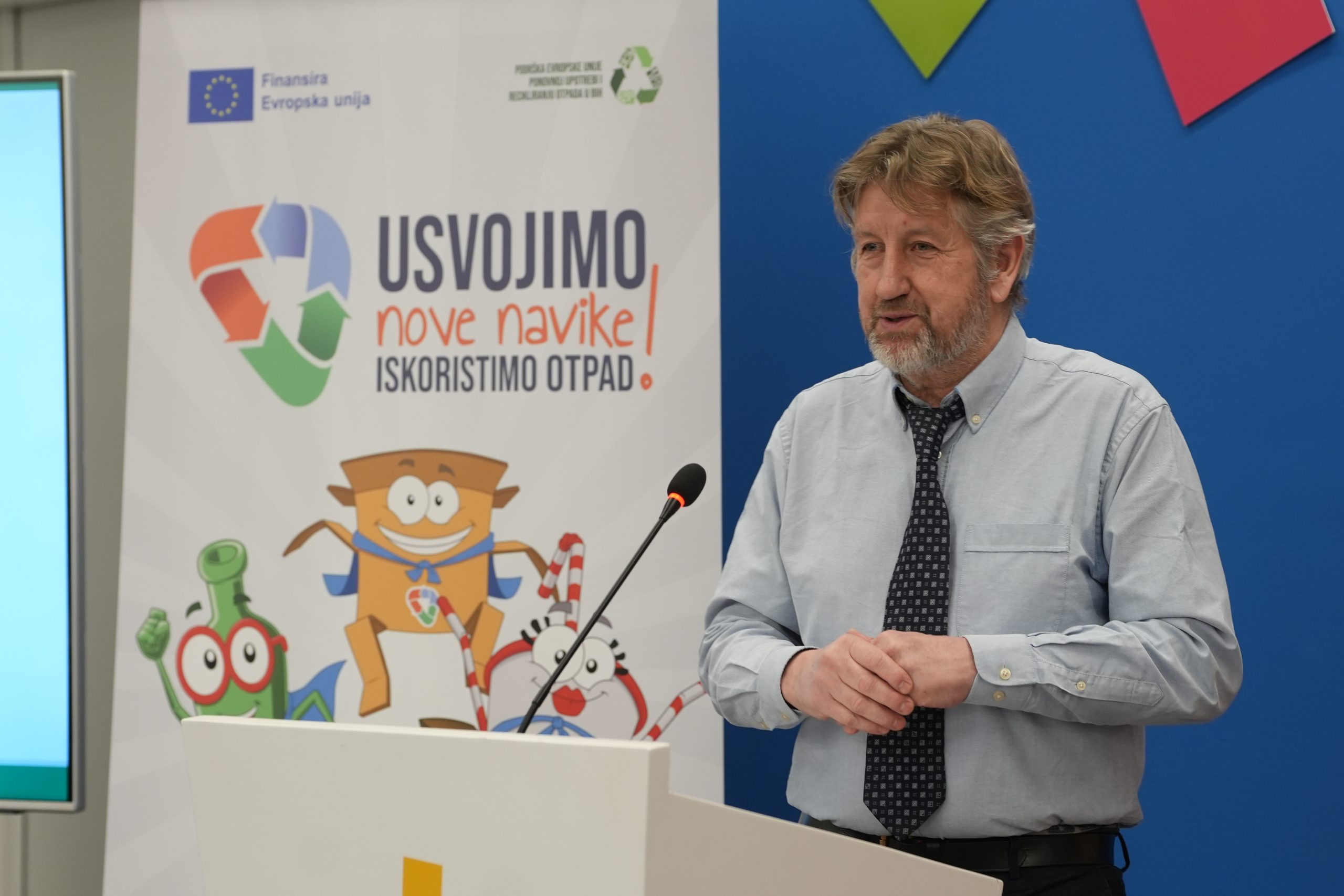
To bring this message to life, the campaign introduced Eco Guardians – a group of friendly, educational heroes designed to engage audiences of all ages.
When waste ends up in the wrong place, nature loses its power. That’s when the Eco Guardians come on the scene. Each of the characters represents a particular waste stream and shows how proper separation gives materials new life.
- Kartonko , the hero of paper and cardboard, reminds us that every box deserves a new opportunity, by turning something old into something new.
- Flaško , the hero of glass, demonstrates the power of infinite regeneration of glass, protecting resources through proper waste separation.
- Plasta , the plastic hero, warns of the dangers of irresponsible plastic disposal and shows how recycling can prevent pollution.
- Bananko , the hero of biowaste, teaches us how food scraps can become compost, new energy, and fertile soil.
Together, they convey a clear message: a banana peel, a glass bottle, a cardboard box and a plastic cup are not trash – but resources.
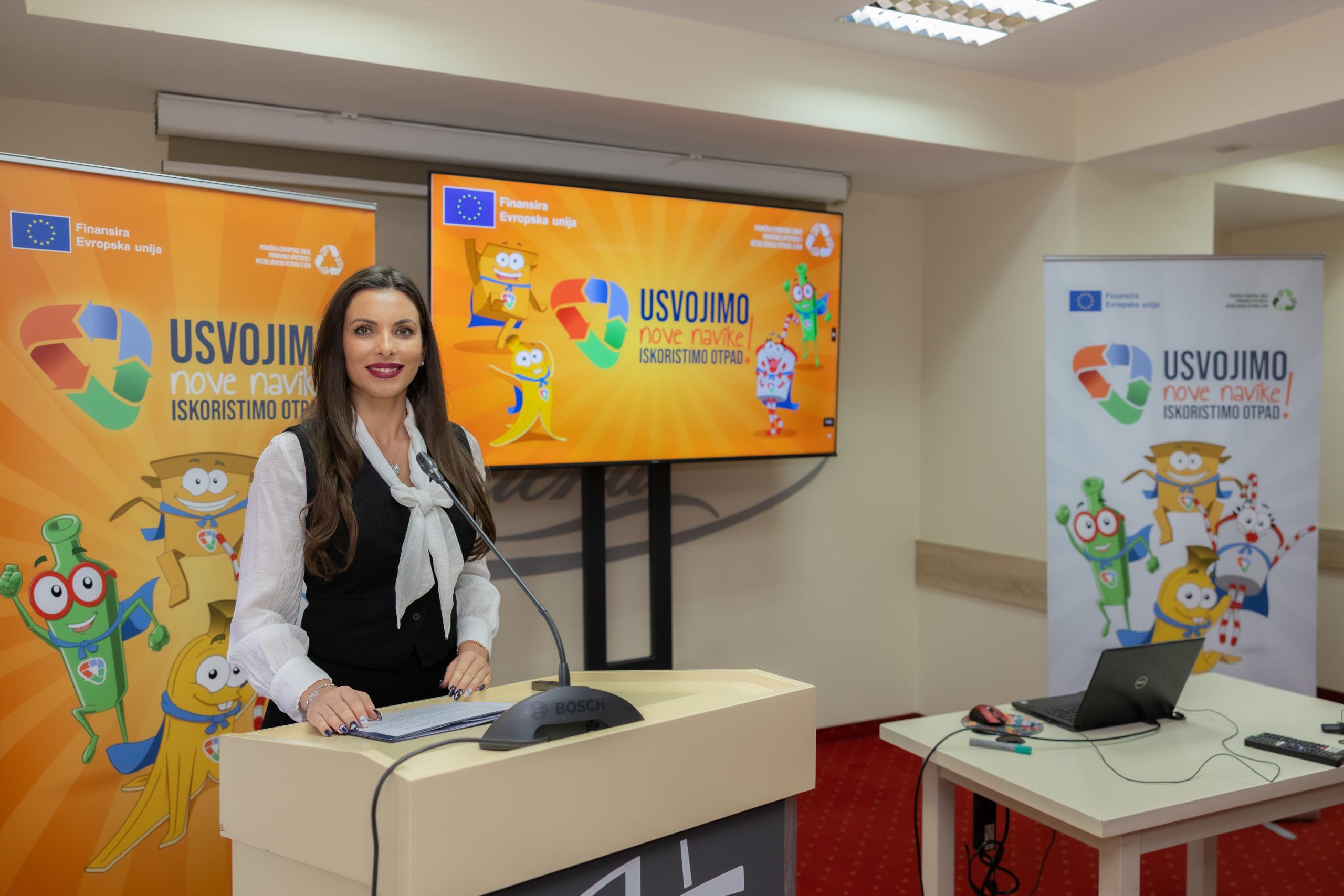
The campaign will be launched with three public events across the country – in Sarajevo, Brčko and at another upcoming event in Banja Luka.
These events bring together representatives of key sectors and key actors on the project, the Delegation of the European Union, experts in the field of waste management and circular economy, as well as partner organizations – emphasizing that improving waste management is a shared responsibility.
In Sarajevo, Europe House also presented the success of its “Trashformers 2025” campaign, a school competition aimed at educating children about good waste management practices. Leaders of sustainable business also contributed in Brcko, including Tamara Đurić, founder and director of Magbago, an ecological fashion brand.
From awareness to action
During 2026, the campaign will be implemented in stages, guiding citizens and competent institutions, raising their awareness and leading them towards knowledge, changing attitudes and daily practice. Following the January launch, activities include regular articles, newsletters, social media content, media interviews and success story videos.
In the spring, the focus shifts to the learning process and active participation, through community competitions in partnership with the Ekograd organization, encouraging recycling through their Recyclomats, as well as the Trashformers 2026 school competition, realized in cooperation with Europe House, with the aim of engaging young people.
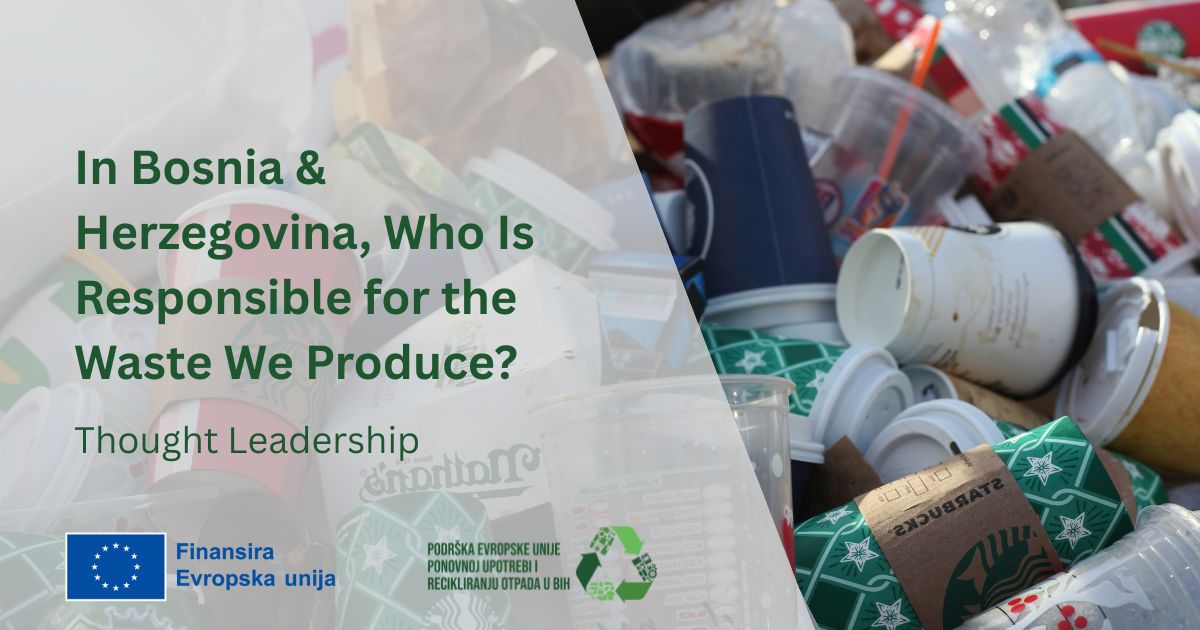
In Bosnia & Herzegovina, Who Is Responsible for the Waste We Produce?
Who is responsible for the waste we produce?
As with all big questions, the answer is not simple. As consumers, we choose what we purchase and how we dispose of it; as businesses, we choose what we sell and how we sell it; while public utility companies (RADs) work within their budgets to collect, sort, and recycle waste. Governments and Local Self Government Units have the task of developing policy and legislation which will improve waste management practices.
In a circular system, waste is no longer a problem to be hidden, exported, or imported – it is a resource to be managed collectively. For Bosnia and Herzegovina, this shift does not depend on a single policy, campaign, or investment, but on the co-ordinated actions of citizens, businesses, and institutions, each playing a distinct and essential role.
When we look at waste in this context, we see that the problem is not owned by one actor alone and in fact the responsibility is shared by all. After all we are all ultimately responsible for the waste we produce as a society.
Challenges
While Waste Management Plans are being developed in line with EU standards and local legislation – which will improve what and how items can be recycled in Bosnia and Herzegovina – it is also important to consider what more can be done now.
It is essential to recognise the challenges citizens face: whether a lack of knowledge about the benefits of reducing waste in BiH; limited access to household recycling infrastructure, or low motivation to recycle because it sits low on a list of more immediate concerns.
There is no point in shying away from these challenges. Acknowledging them does not mean that citizens are powerless.
Households: Where Circularity Begins
As consumers, we can flip the question of waste responsibility on its head and ask: who is responsible for the waste we don’t produce? The biggest impact we can have on waste output is to prevent it in the first place—and that starts at home.
There is a model known as the “waste hierarchy”, which ranks waste management options according to what is best for the environment:
- Prevention
- Preparing for Re-Use
- Recycling
- Recovery
- Dispose
Often, when people think about improving their waste impact, they focus on recycling. However, within the waste hierarchy, recycling sits only in third place. Reducing and reusing are not only easier but far more impactful than recycling, recovery, or disposal. And waste prevention sits at the top of the hierarchy and delivers the greatest economic and environmental benefits.
Households are the first point at which materials either retain value or become waste. How citizens sort, store, repair, reuse, or discard products directly determines whether materials can re-enter the economy or are lost to landfill.
In Bosnia and Herzegovina, many citizens already practise informal circularity, repairing appliances, reusing packaging, and extending product life out of necessity. Yet without consistent collection systems, clear guidance, and trust that sorted waste will be treated properly, these efforts can often feel futile.
The transition requires more than telling people to “recycle better”. It requires confidence, clarity, and convenience – systems that reward participation. When citizens understand why separation matters, have the ability to recycle and can see the impact of their actions, behaviour change follows.
Businesses: From Waste Generators to Solution Providers
Businesses sit at the centre of material flows. They design products, choose packaging, manage logistics, and influence consumption patterns. In a linear model, waste is a cost. In a circular one, it becomes a strategic asset.
For companies in Bosnia and Herzegovina, circularity offers clear opportunities:
- Reduced material costs through reuse and secondary raw materials.
- New markets for repair, refurbishment, and recycling services.
- Stronger alignment with EU standards, improving export competitiveness.
As part of CETAP, a Waste Exchange Platform is being designed and developed. This platform will allow businesses across the country to sell their ‘waste’ to other organisations that can use these materials as valuable inputs and resources.
We’re also reviewing Extended Producer Responsibility (EPR) schemes which are a critical tool in this transition. They shift accountability beyond disposal and towards full product lifecycle responsibility—encouraging better design, financing collection systems, and supporting recovery infrastructure.
However, EPR works only when businesses are engaged as partners, not just payers. Transparent rules, fair enforcement, and predictable systems allow companies to invest confidently in circular solutions.
Institutions: Enabling the System to Work
Governments and public institutions hold the framework together. Their role is not to manage waste directly, but to create the conditions in which circular system for waste management can function.
In Bosnia and Herzegovina’s complex governance landscape, coordination is just as important as legislation. Aligning entity-level regulations, strengthening enforcement, supporting municipalities and cantons, and ensuring data transparency are all essential steps.
Equally important is public trust. When citizens and businesses believe institutions are capable, consistent, and fair, participation increases. Circular economy policies succeed not through control, but through credibility.
Institutions also play a crucial role in enabling investment—using economic instruments, incentives, and funding mechanisms to unlock private-sector participation and modernise infrastructure.
Shared Responsibility, Shared Benefit
A circular economy challenges the idea that responsibility for waste management can be isolated. No single actor can deliver change alone.
- Households cannot separate waste if systems fail them.
- Businesses cannot invest if rules are unclear or unevenly applied.
- Institutions cannot enforce circularity without public and private buy-in.
But when these roles align, momentum builds quickly.
Bosnia and Herzegovina has strong foundations for this shared approach: deep-rooted community values, a growing private sector, and increasing alignment with European Union policy frameworks. What is needed now is a collective shift in mindset—from “who is to blame?” to “how do we act together?”
A Circular Future Is a Collective Choice
Responsibility for waste is not about pointing fingers; it is about recognising inter-dependence.
Every sorted bottle, every redesigned product, and every aligned policy decision contributes to a system where materials retain value and waste loses meaning. Circularity is not imposed—it is co-created.
CETAP exists to support this shared journey: strengthening policy, engaging institutions, supporting businesses, and building public awareness so that Bosnia and Herzegovina can move from fragmented responsibility to shared solutions.
Because the circular transition will not be delivered by one actor alone—but by all of us.

Finding Gold in Your Electronic Waste: Turning a Hidden Problem into a Circular Opportunity
Project CETAP — European Week for Waste Reduction (EWWR)
Every year, households and businesses across Bosnia and Herzegovina quietly accumulate a growing mountain of old phones, broken chargers, forgotten laptops, unused cables, damaged hairdryers, and discarded televisions. We rarely think of these items once they stop working—but within this overlooked waste stream lies something far more valuable than most people imagine.
Waste from Electrical and Electronic Equipment (WEEE) also known as electronic waste or e-waste is one of the fastest-growing waste streams globally, and also one of the most resource-rich. Inside even a small mobile phone, you will find tiny but valuable quantities of rare earth elements such as gold, silver, palladium, copper, lithium. These materials are essential for technology, renewable energy systems, electric vehicles, and many sectors that underpin a modern economy.
Yet in Bosnia and Herzegovina—like in many parts of Europe—a significant portion of WEEE never reaches official collection points. Instead, it sits in drawers, is thrown into mixed waste bins, or is handled informally, leading to environmental harm and lost economic potential.
As part of the European Week for Waste Reduction (EWWR), Project CETAP is shining a spotlight on the hidden value in our electronic waste, and how we can unlock it through better habits, stronger systems, and a shift towards a circular economy.
Why is WEEE so important for a circular economy?
Moving from a linear “take–make–dispose” model to a circular system means keeping materials in use for as long as possible. WEEE is one of the clearest examples of why this shift matters.
- Valuable materials are being thrown away
Many electronic devices contain precious metals with surprisingly high market value. For example:
- 1 tonne of used mobile phones contains significantly more gold than 1 tonne of gold ore. 1 ton of ore gets 1g of gold. But you can get the same amount of gold from recycling just 41 mobile phones.
- Recycling aluminium uses 95% less energy than producing new aluminium.
- Copper, lithium, and rare earth elements are essential for green technologies—yet most remain unrecovered.
When WEEE is lost to landfill, these materials must be mined again, contributing to environmental damage, resource depletion, and carbon emissions.
- Improper disposal harms human health and the environment
Electronics contain hazardous substances such as lead, mercury, cadmium, flame retardants, and chemicals that—when not handled properly—can contaminate soil, water, and air. Informal burning or dismantling poses serious risks to communities.
- Recovering materials creates economic opportunities
A well-functioning WEEE collection and recycling system:
- Creates skilled green jobs
- Reduces the need for imported raw materials
- Supports domestic recycling industries
- Helps municipalities comply with EU Waste Package requirements
For Bosnia and Herzegovina, this is not just an environmental issue—it is an economic opportunity.
EWWR: Small actions, big impact
The European Week for Waste Reduction (EWWR) encourages individuals, schools, companies, and institutions across Europe to reduce waste, reuse materials, and improve recycling behaviours. This year’s theme highlights the importance of giving products a new life and preventing valuable resources from being lost.
Project CETAP is contributing to EWWR by raising awareness of the hidden value in WEEE and encouraging citizens to adopt simple, practical habits.
Five actions you can take today
Small steps that help Bosnia and Herzegovina build a circular future.
- Empty your “tech drawer”
We all have one—a drawer full of old phones, USB sticks, remote controls, chargers, or random cables. Clearing it out is the easiest way to start.
- Bring unusable electronics to official collection points
Never place WEEE in the household bin. Approved collection points ensure safe handling and proper recycling. ZEOS is a non-profit in BiH which has collection points all across the country for WEEE, you can find a map of all their recycling points here: https://www.zeos.ba/en/43/pages/21/map-with-containers
- Donate functional devices
Old but working laptops, tablets, and phones can be refurbished and reused by schools, charities, and low-income families.
- Repair instead of replace
Many devices can be fixed cheaply. Repairing extends their life, reduces waste, and supports local repair businesses.
- Choose greener electronics
Look for devices that use recycled materials, have replaceable components, or come with long warranties.
How Project CETAP supports the transition
As Bosnia and Herzegovina works towards EU alignment and a modern circular economy WEEE is a key focus area within Project CETAP. Our work includes:
- Analysing the potential for improved management of special waste streams, including WEEE
- Supporting harmonisation with the EU Waste Package
- Raising national awareness on correct waste handling and circular behaviours
- Engaging municipalities, schools, private sector partners, and citizens
- Delivering a nationwide public awareness campaign launching January 2026
By strengthening systems and educating the public, CETAP helps turn what is currently a waste challenge into an opportunity for sustainable growth.
There is gold in your waste—let’s not throw it away
WEEE is often seen as a burden, but in reality it is one of our most valuable secondary resources. Every old phone, broken toaster, or unused cable contains materials that can be recovered and transformed into something new.
During EWWR, and throughout the months ahead, Project CETAP invites everyone in Bosnia and Herzegovina to take action. Together, we can reduce environmental impact, support a more resource-efficient economy, and unlock the hidden value in the devices we no longer use.
Let’s adopt new habits. Let’s use waste.
A circular future starts with the choices we make today.

From Linear to Circular: Rethinking the Economy for a More Resilient BiH
For decades, Bosnia and Herzegovina’s economy—like much of the world’s—has been built on a linear model: take, make, use, and dispose. It’s a system that has delivered industrial growth, but also one that has left behind growing landfills, wasted resources, and rising environmental costs.
A linear economy has historically helped develop innovation, put money into the economy as it’s increasing our consumerist behaviour - but we realise now that a linear economy is not a sustainable model. The waste we leave behind is not just a missing an opportunity to be transformed into a resource, when it’s not dealt with correctly it becomes costly both environmentally and economically.
Now, as Europe accelerates its transition towards a circular economy, Bosnia and Herzegovina (BiH) stands at a pivotal moment. The shift from linear to circular is not simply an environmental choice—it is a strategic and economic opportunity to strengthen competitiveness, create local jobs, and build long-term resilience.
What Does a Circular Economy Mean for BiH?
A circular economy replaces waste with resourcefulness. It means designing out waste and pollution, keeping products and materials in use for as long as possible, and regenerating natural systems. In practical terms, it means turning yesterday’s waste into tomorrow’s raw material.
For BiH, this transition could bring tangible benefits:
- Reduced import dependency on raw materials by reusing what already exists within our borders.
- New green industries and innovation, from repair and remanufacturing to recycling and eco-design.
- Job creation, particularly in local communities where waste is generated and managed.
- Improved environmental quality—cleaner rivers, greener cities, and healthier living conditions.
These are not abstract ideas. Across Europe, circular models have already delivered measurable results: lower waste generation, new revenue streams, and more stable economies. For BiH, adopting these principles can unlock growth and investment in sustainable sectors, while further aligning with EU environmental standards.
An Economic Shift Rooted in Resilience
In a linear economy, the value of the product disappears the moment it is thrown away. In a circular one, value circulates—retained through reuse, recycling, and smarter design. This makes economies more resilient to shocks such as resource shortages or price fluctuations, while being less dependent on imports.
Bosnia and Herzegovina currently imports a large proportion of its raw materials. By building systems that keep resources in circulation, the country can protect itself against global market volatility. Circular models also encourage innovation and entrepreneurship—offering small and medium-sized enterprises new ways to compete and grow.
Moreover, global investors are increasingly prioritising sustainability. Countries that can demonstrate circularity, transparency, and green credentials are becoming magnets for funding. For BiH, embracing the circular transition means not just protecting the environment, but future-proofing the economy.
Turning Policy into Practice
Circularity requires collaboration: between governments, businesses, academia, and citizens. This is where Project CETAP (Circular Economy Transition and Awareness Programme) plays a key role. Supported by the EU and local partners, CETAP is helping Bosnia and Herzegovina develop the legal, institutional, and cultural foundations for a circular future.
CETAP’s mission is twofold:
- Policy support – helping align national waste and resource management frameworks and Plans with the EU Green Deal, which looks to make the EU become the first climate neutral area by 2050.
- Public awareness and engagement – inspiring citizens, schools, municipalities, and companies to rethink waste as value, through our public awareness campaign which is due to launch in January 2026.
The transition process will not happen overnight but it will happen. And every action—every separated bottle, repaired appliance, or recycled material—builds momentum. CETAP’s approach is rooted in the AKAP model: Awareness, Knowledge, Attitude, and Practice. Awareness begins with understanding why circular principles (reduce, reuse, recycle and recover) matter.
Building a Future That Lasts
Circular economy thinking offers a new vision for Bosnia and Herzegovina—one where progress doesn’t come at the expense of the planet. It challenges the outdated notion that growth and sustainability are opposites, showing instead that smart resource management fuels prosperity.
By rethinking production and consumption, BiH can reduce environmental pressure, stimulate innovation, and strengthen economic sovereignty. More importantly, it can join the growing European community of nations proving that sustainability and success can go hand in hand.
The move from linear to circular is not a step back—it’s a leap forward. A leap towards cleaner industries, more stable jobs, and a future that regenerates rather than depletes. With the right mix of policy, partnership, and public participation, Bosnia and Herzegovina can become a regional leader in circular transformation—showing that resilience begins with rethinking how we use what we have.
About Project CETAP
The Circular Economy Transition and Awareness Programme (CETAP) is an EU-funded initiative supporting Bosnia and Herzegovina’s shift towards a sustainable, resource-efficient economy. By combining policy alignment, stakeholder engagement, and public awareness, CETAP aims to build a greener, more resilient future for all.

Circular Living: How Reuse, Repair, and Resourcefulness Are Already Part of Bosnian Life
Circular Living: How Reuse, Repair, and Resourcefulness Are Already Part of Bosnian Life
For many people across Bosnia and Herzegovina, the principles of circular living are anything but new. They are woven into daily habits, family traditions, and community life. From careful reuse to creative repair, Bosnians have long practised the art of making things last.
Tradition Meets Modern Sustainability
Generations in Bosnia and Herzegovina have grown up with a deep respect for resources: glass jars turned into pantry staples, clothes mended and passed down, leftover food transformed into tomorrow’s meal, and food waste turned into compost.
Today, these values remain strong. In towns and villages, it’s common to see shoes repaired rather than discarded, furniture restored instead of replaced, and garden produce carefully preserved. These are not merely nostalgic customs; they are living examples of circular thinking.
Everyday Reuse and Repair
Walk through a neighbourhood market and you’ll find countless signs of this resourcefulness. From jars refilled with homemade jams and ajvar, to old tools handed down through families, reuse is part of everyday life. Tailors and cobblers—once thought to be disappearing trades—are thriving in many communities, offering affordable repairs that keep clothing and footwear in circulation.
In rural areas, where self-sufficiency remains a point of pride, circular living is even more visible. Composting kitchen scraps, reusing building materials, and repairing farm equipment is the done thing. These practices reduce waste, save money, and keep valuable resources in use.
The Circular Spirit in Cities
Urban centres are seeing a revival of repair and reuse culture too, and looking to use more sustainable materials to make goods. Across Bosnia & Herzegovina, entrepreneurs are creating successful businesses which focus on sustainability and support a circular economy.
In fact one used clothing retail chain has only 2% waste from their sorting process, meaning almost 98% of all incoming garments are re-used or resold.
Fashion brand MAGBAGO based in Bijeljina produces stylish clothing using plant-based and biodegradable materials to drive sustainable fashion. Tamara Djuric, an ecopreneur and founder of MAGBAGO said:
"A more circular economy is essential for Bosnia and Herzegovina because it builds on traditions of resourcefulness and respect for nature that have always been part of our culture. Our grandmothers already had this mindset long ago – saving, reusing, and repurposing everything, from glass jars and bottles to fabrics. I see great potential in simply bringing back that way of thinking, and with it, we can reduce waste, spark innovation, and create healthier communities for the future."
Even digital platforms are joining the movement. Online marketplaces for second-hand goods are booming, giving items a second life and reducing the need for new production.
These ventures and others like them showcase how the people of Bosnia and Herzegovina’s are bringing back a history of ingenuity, restoration and circular practices into a 21st century economy.
A Culture of Resourcefulness
Circular living is about more than recycling bins or government targets. It’s a mindset: valuing what we have, finding new uses for old things, and sharing resources within our communities. Bosnia and Herzegovina has a natural advantage here. The culture of resourcefulness is already embedded in daily life. What’s needed now is support to scale these practices and connect them to modern systems of collection, sorting, and recycling.
Linking Past and Future
As Bosnia and Herzegovina moves toward EU membership and embraces ambitious environmental goals, these long-standing habits can form the foundation for national circular economy strategies. Rather than starting from zero, policymakers and businesses can learn from the ingenuity of everyday people.
Project CETAP (Circular Economy Transition Action Plan) aims to highlight and strengthen this connection. By celebrating local traditions of reuse and repair, and by supporting modern infrastructure for recycling and recovery, CETAP is helping to reflect cultural wisdom into modern policy and practice.
The Opportunity Ahead
Imagine a future where the entire country benefits from this natural circular mindset. Where small-town repair cafes are supported by municipal programmes. Where every city offers collection points for reusable goods. Where schools teach children not just to recycle, but to value materials from the start.
Bosnia and Herzegovina already holds the blueprint for such a future. It’s in the homes where jars are refilled and clothes are mended. It’s in the neighbourhood markets where second-hand goods change hands. And it’s in the collective spirit of a people who know that nothing should be wasted.
Circular living is not a new idea. It’s a way of life. By recognising and expanding these historic traditions, Bosnia and Herzegovina can lead the way toward a truly regenerative, resilient economy—proving that the best solutions for tomorrow may already be found in the wisdom of yesterday.

The Hidden Cost of Waste: What Happens to Waste in Bosnia and Herzegovina?
Waste can often be thought of as out of sight, out of mind. Once it leaves our hands and goes into a bin we rarely give it a second thought. But where does it all go? And what is the real cost of this growing mountain of waste to our environment, our health, and our economy?
In Bosnia and Herzegovina, the truth is both alarming and urgent.
The Journey of Waste in BiH
Every day, households, businesses, and industries across the country generate thousands of tonnes of waste. In fact, Bosnia and Herzegovina (BiH) produced 1.2 million tons of municipal waste in 2021, which was a 1.8% increase in the previous year. Each inhabitant of Bosnia and Herzegovina produced an average of 356kg waste - which is the same weight as a fully grown polar bear!
Some of it is collected by municipal services and taken to landfills. Some of it is burned in open spaces. Though the Stockholm Environment Institute (SEI) found that around 25% of all disposed waste ends up in illegal dump sites in BiH. The UNDP found that there were over 1,400 illegal waste disposal sites across the country, these illegal sites are not only unsightly but dangerous—breeding grounds for disease, contamination, and even fire.
And alarmingly in April 2025 only six landfills in Bosnia and Herzegovina met EU standards which means that even the majority of waste which is landfilled legally still fail to meet environmental standards.
These sites often lack impermeable bases, proper gas collection, or leachate treatment. Waste includes broad categories like hazardous or organic materials mixed with general trash, without sorting. This means hazardous substances can seep into the soil and water, releasing toxic gases into the air and polluting ecosystems for decades to come.
Environmental Impact: A Threat to Nature and Climate
Waste that ends up in nature doesn’t just disappear. Plastics break down slowly, a single plastic bottle decomposes over 450 years and turns into microplastics, which can enter the water supply and ultimately the food chain.
Organic waste dumped in landfills emits methane, a greenhouse gas which has a Global Warming Potential (GWP) 80 times more potent than carbon dioxide in the short term. GWP is a measure of how much heat a greenhouse gas traps in the atmosphere.
While chemicals from improperly disposed electronics, batteries, and medical waste can poison animals and pollute water sources.
Bosnia and Herzegovina has a rich biodiversity with around 5,000 vascular plant species documented which is the equivalent to roughly 30% of Balkan endemic flora, making the region vital for plant conservation.
Sutjeska National Park, one of the country’s three national parks, alone supports 2,600 species of vascular plants, including endemic black pines and beech trees—some over 300 years old—in the ancient Perućica forest.
Among fauna, BiH has native brown bears, Balkan chamois, wolves, lynx, wild cats, and over 300 bird species, including golden eagles and peregrine falcons, thriving in protected landscapes
All of this is under direct threat, without strong waste management systems BiH risks irreversible damage to natural heritage.
Economic Impact: Waste is Wasting Money
Poor waste management is not only an environmental issue. It’s an economic one.
Managing illegal dumping, cleaning rivers, and remediating contaminated land costs municipalities millions each year—funds that could be better spent on schools, healthcare, and infrastructure. At the same time, the country is losing out on the economic value of the materials currently being discarded.
Aluminium, plastics, paper, textiles, and organic matter all have potential second lives. Yet, when mixed and buried in landfills, that value is lost. A functioning circular economy could unlock this potential, turning waste into a resource and creating new opportunities for jobs and businesses.
Additionally, in BiH there is no industrial or hazardous waste disposal site in the country, this in turn means that much of the hazardous waste generated in BiH is exported to EU nations for treatment which is a costly and unsustainable approach.
Health Impact: A Silent Crisis
Improperly managed waste directly affects public health. Open burning releases harmful particulates and carcinogens. Leachate from landfills contaminates groundwater used for drinking. Mosquitoes, rats, and other disease vectors thrive in illegal dumpsites.
Communities living near unmanaged waste sites often report higher rates of respiratory illnesses, skin conditions, and gastrointestinal problems. Children are particularly vulnerable. The long-term costs to the healthcare system, productivity, and wellbeing are substantial.
Why Change Is Urgent?
Bosnia and Herzegovina is not alone in facing these challenges. Across the Western Balkans, countries are grappling with the legacy of underinvestment in waste infrastructure. But change is coming.
As part of its path toward EU accession, BiH will need to align with the bloc’s ambitious environmental and circular economy targets. That means reducing landfill dependency, improving recycling rates, and investing in systems that prioritise prevention, reuse, and recovery.
But this isn’t just about compliance. It’s about building a cleaner, fairer, and more sustainable future for everyone.
Advances are already being made and, supported by the European Union, Sweden and the European Bank for Reconstruction and Development (EBRD), a new regional centre in Živinice has been operating since April 2025. It is now the first sanitary landfill with an integrated recycling yard and gas management in Tuzla canton. It serves around 100,000 residents and includes infrastructure to treat leachate and capture methane gas.
The Role of CETAP: Driving the Transition
Project CETAP (Circular Economy Transition Action Plan) was created to support this transformation to reduce waste, improve recycling and help develop a circular economy. By helping local governments, businesses, and communities understand the true cost, and value, of waste, CETAP is laying the groundwork for change.
Through data-driven research, public awareness campaigns, and the development of pilot programmes, CETAP is:
- Identifying key waste streams and opportunities for circularity.
- Supporting local authorities in upgrading waste collection and sorting systems.
- Engaging citizens to reduce, reuse, and recycle.
- Advocating for the investment in circular solutions.
Waste doesn’t have to be a burden. It can be an opportunity.
What Can You Do?
Tackling the waste crisis in BiH requires collective effort. Everyone has a role to play:
- Sort your waste: Separate recyclable materials from general waste. Encourage your local authorities to provide better sorting facilities.
- Avoid single-use plastics: Choose reusable alternatives whenever possible.
- Report illegal dumping: Speak up and demand accountability.
- Support circular businesses: Buy local, repair instead of replace, and look for products made with recycled content.
Small actions, multiplied across communities, create big change.
Toward a Cleaner Bosnia and Herzegovina
The hidden cost of waste is too high to ignore. From polluted rivers and rising health problems to missed economic opportunities, the current system is unsustainable.
But with the right policies, investments, and public support, Bosnia and Herzegovina become a circular economy. One where waste is designed out, materials are reused, and nature is protected.
Project CETAP is proud to be part of this essential transition. Because waste doesn’t just disappear. It shapes our future.

What Is a Circular Economy—and Why Does Bosnia and Herzegovina Need One?
Imagine a world where waste doesn’t exist. Where everything we produce, use, and consume has another life, another use, and another purpose. This is the vision of a circular economy—a model that offers not only a solution to the mounting environmental crisis but also a promising pathway to economic resilience. For Bosnia and Herzegovina, the time to embrace this transformation is now.
From Linear to Circular: What Does It Mean?
For many decades, most of the world has followed a linear economic model: take, make, use, and discard. Raw materials are extracted, products are manufactured and consumed, and what's left becomes waste. This model depends on firstly an infinite amount of resources, and secondly, an infinite capacity to absorb endless pollution and waste —both of which, in reality, are finite.
The circular economy flips this logic. Instead of discarding resources, we keep them in use for as long as possible. Products are designed to be reused, repaired, refurbished, or recycled. And by separating organics from our landfill we can put the nutrition from food waste back into the earth.
In practical terms, it means designing clothes that can be recycled, encouraging refillable packaging, turning organic waste into compost, and ensuring electronics can be easily repaired. It's not just about environmental protection; it’s a smarter way of doing business.
Why Does Bosnia and Herzegovina Need a Circular Economy?
Like many countries in the Western Balkans, Bosnia and Herzegovina faces a range of environmental and economic challenges. Waste management systems are outdated. Illegal dumping is widespread. Landfills are overburdened. Meanwhile, industries rely heavily on imported raw materials, creating both economic dependency and vulnerability. A circular economy could address all of this.
Firstly, by repurposing and recycling what was once seen as waste means that less materials are sent to landfills. In 2019, only around 2.2 % of waste was recycled in BiH (the rest was landfilled or illegally dumped), and current figures suggest it’s still between 2-5%. In contrast to this Eurostat states that in 2023, the EU recycled 246 kg per person—which represents 48.0 % of all municipal waste generated.
In BiH much of what could be recovered—plastic, paper, metals, and organics —ends up in landfills or illegally dumped in nature. With the right infrastructure, policies, and public awareness, these valuable materials could be kept in the loop of the economy.
Secondly, a circular economy helps create jobs and foster local innovation. Circular practices like repair, remanufacturing, composting, and material recovery are often more labour-intensive than linear alternatives. That means more opportunities for small businesses, entrepreneurs, and young people looking for meaningful work.
Thirdly, it would strengthen Bosnia and Herzegovina’s economy. By reducing dependence on raw material imports and boosting the use of secondary materials, industries become more resilient to global shocks. Circularity can also make local supply chains more efficient and less wasteful, helping businesses save money while benefiting the environment.
Finally, it's about public health and quality of life. Cleaner environments, fewer illegal dumps, and better air and water quality benefit not just our environment but also the people who inhabit it, whether in a village, town or city. A circular economy supports a more liveable, healthy, and sustainable Bosnia and Herzegovina for all.
Learning from Others, Leading Our Own Way
Countries across Europe are already putting circular economy principles into practice. In the Netherlands, repair cafes and sharing platforms are commonplace. In Slovenia, Mariborm, a once-declining industrial city has become a beacon of circular innovation. The EU's Circular Economy Action Plan is guiding ambitious targets for waste reduction, product design, and green job creation. Bosnia and Herzegovina doesn’t need to start from scratch—but it does need to act.
Project CETAP (Circular Economy Transition Action Plan) exists to help drive that change. By supporting policy reform, piloting circular solutions, and raising public awareness, CETAP is laying the foundation for a new, regenerative economic model. One that serves people and planet.
What Can You Do?
Circular economy isn’t just a matter for policymakers or big businesses. It starts with all of us.
Here are a few simple steps anyone can take:
● Reduce waste: Buy only what you need. Choose products with less packaging. Bring your own bag.
● Reuse and repair: Fix broken items instead of throwing them away. Pass things on instead of throwing them out.
● Recycle correctly: Learn the rules in your municipality and sort your waste accordingly.
● Support local: Choose businesses that prioritise sustainability, use local materials, or offer repair services.
Every small action contributes to a bigger shift. As awareness grows, so too does the momentum for structural change.
A Circular Future for Bosnia and Herzegovina
Transitioning to a circular economy won’t happen overnight. It requires long-term commitment, cross-sector collaboration, and a shift in mindset. But the rewards—economic, environmental, and social—are worth the effort.
Bosnia and Herzegovina stands at a crossroads. With vision and determination, it can become a regional leader in circular economy innovation. Project CETAP is here to support that journey—connecting communities, guiding policy, and inspiring a new way forward.
Because waste is not just a problem to manage. It’s a resource to unlock. And the circular economy is how we turn today’s challenges into tomorrow’s opportunities.
It’s time to bin bad habits and recycle waste.

Waste management is not just a utility company’s job – here’s why
While utility companies are responsible for collecting and transporting waste, real progress happens only when everyone plays their part.
By separating waste, citizens make recycling easier and reduce the volume going to landfills. The private sector can develop green businesses, improve production processes, and manage industrial waste responsibly. Educational institutions teach the youngest generations the importance of cleanliness and proper disposal. Local authorities create regulations, plan infrastructure, and support waste-related projects.
Every link in this chain plays a vital role. Waste management is a shared responsibility, which is why CETAP includes a wide range of partners and citizens in its activities. Through open dialogue, joint identification of needs, and the creation of practical recommendations, we’re working on systemic solutions that will improve waste management in Bosnia and Herzegovina in the long term.
In the end, change starts with each individual. With small everyday decisions, we can make a big difference in how we treat waste.

From waste to resource: how waste can create new value
In a circular economy, waste isn’t seen as the end—but as the beginning of something new. Old paper becomes new packaging, glass bottles are reused, and organic waste is turned into compost for gardens.
In Bosnia and Herzegovina, there are companies that recycle plastic, textiles, and metals, as well as innovative initiatives that turn waste into art, furniture, or new products. Some cities have successful “green cooperatives” that employ people from vulnerable groups through recycling activities.
Recycling saves energy, cuts costs, extends landfill life, and creates green jobs. Every bottle, can, or paper item that gets recycled instead of being dumped is a step towards a more sustainable future.
Through communication and education, CETAP promotes the idea of waste as a resource and connects local actors who already see the opportunity in it. The goal is to foster the recognition of potential in waste and develop value chains that benefit both communities and the environment.