

How CETAP Used Behavioural Science to Understand Recycling in Bosnia and Herzegovina
Understanding Behaviour Before Changing It
Before asking citizens to change how they manage waste, CETAP took a step back to understand a more fundamental question:
Why do people recycle—or not recycle—in the first place?
To answer this, CETAP conducted a nationwide behavioural survey using the COM-B model, a globally recognised framework for understanding behaviour.
What is COM-B?
COM-B is a behavioural science model that explains that behaviour (B) is driven by three key factors:
- Capability – Do people have the knowledge and skills to perform the behaviour?
- Opportunity – Does the environment enable or support the behaviour?
- Motivation – Do people want or intend to perform the behaviour?
For behaviour to change, all three must be present.
CETAP structured its survey around these components, asking:
- Five quantitative questions per category
- One qualitative question to capture deeper insights
This approach ensured both measurable data and real human perspectives. The survey gathered responses from across the Federation of Bosnia and Herzegovina, Republika Srpska and Brčko District. Providing a comprehensive picture of recycling behaviours across the country.
What the Research Revealed
- Capability: A Knowledge Gap
The findings showed that many citizens are uncertain about how to recycle correctly.
While awareness of recycling exists, practical understanding is limited. Respondents frequently expressed confusion about:
- Waste separation rules
- Which materials are recyclable
- What happens to waste after collection
This highlights a clear need for simple, consistent, and visible public education.
- Opportunity: System Barriers
Even when people are willing to recycle, they are often constrained by their environment.
The survey revealed:
- Limited access to recycling infrastructure
- Inconsistent availability of containers
- Perceived inconvenience
Additionally, some respondents expressed low trust in the system, questioning whether separated waste is ultimately recycled.
This demonstrates that infrastructure and system visibility are critical to behaviour change.
- Motivation: Positive but Not Habitual
Encouragingly, most respondents recognise the importance of recycling and express a willingness to participate.
However:
- Recycling is not yet embedded as a daily habit
- It is often seen as secondary or optional
- Convenience strongly influences behaviour
This suggests that while motivation exists, it requires reinforcement through ease, visibility, and normalisation.
What This Means for Behaviour Change
The key takeaway from the survey is clear: Citizens in Bosnia and Herzegovina are willing to recycle but they feel unsupported in doing so effectively. This insight directly informs CETAP’s public awareness campaign:
- Awareness & Knowledge (Capability): Clear, accessible guidance on how to recycle – CETAP is adding signage to recycling sites that exist to help showcase what can be recycled.
- System Visibility (Opportunity): We are working with municipalities and waste operators to improve Waste Management Plans with the goal of this to then impact infrastructure and communication
- Habit Formation (Motivation): Encouraging simple, repeatable actions that make recycling part of everyday life, by hosting community and school competitions we will help encourage good recycling habits.
From Insight to Action
By grounding its campaign in behavioural science, CETAP ensures that its interventions are not based on assumptions—but on real evidence.
This approach strengthens:
- Policy alignment with EU waste standards
- Public engagement strategies
- Long-term sustainability of behaviour change
Ultimately, understanding behaviour is the first step toward changing it—and CETAP is using that insight to help Bosnia and Herzegovina transition towards a more circular future.

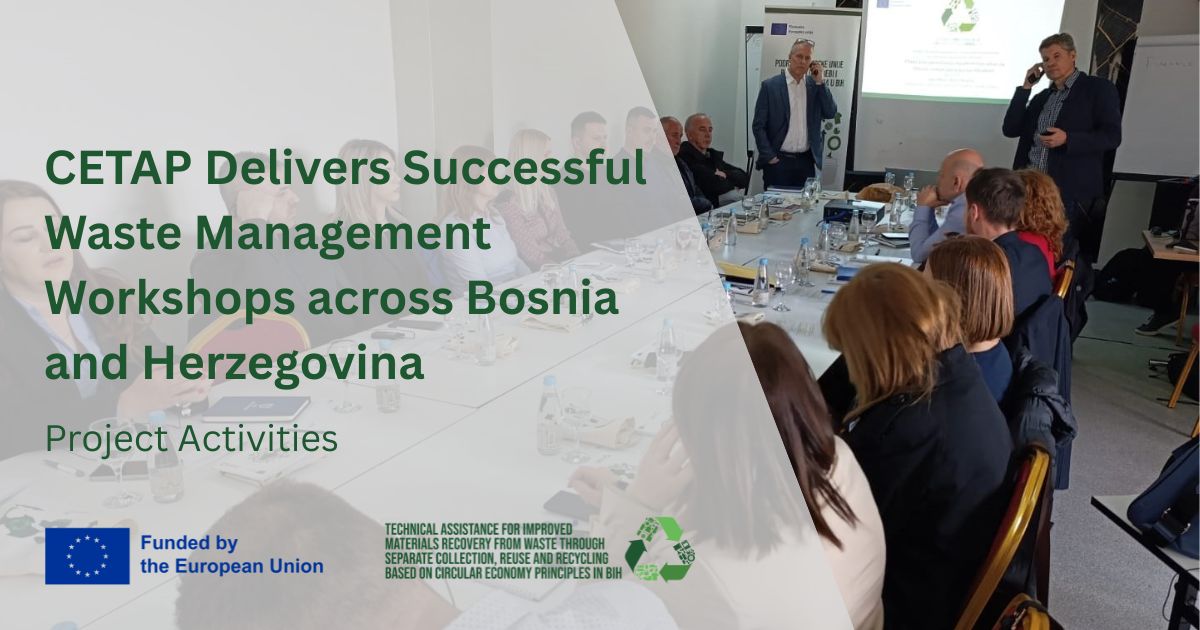
CETAP Delivers Successful Waste Management Workshops across Bosnia and Herzegovina
Within the CETAP project in Bosnia and Herzegovina, successful workshops were held in Banja Luka, Odžak, Travnik, and Sarajevo in the period from 23 to 26 March 2026. The trainings brought together representatives of local authorities, utility companies, and other relevant stakeholders, with the aim of strengthening capacities for circular waste management.
During the workshops, key topics were covered, including strategic waste management planning, the application of economic instruments and financing mechanisms, as well as the importance of waste data collection and analysis for informed decision-making. Special focus was placed on the development of waste management plans and their implementation at the local level.
Lectures were delivered by international experts from the Stockholm Environment Institute, Tomas Thernström and Harri Moora, as well as local CETAP team experts Elma Kavazović and Amela Lepić, specialists in waste management. Participants expressed satisfaction with the organization and content of the workshops, highlighting their practical value and significance for improving local waste management systems.


