

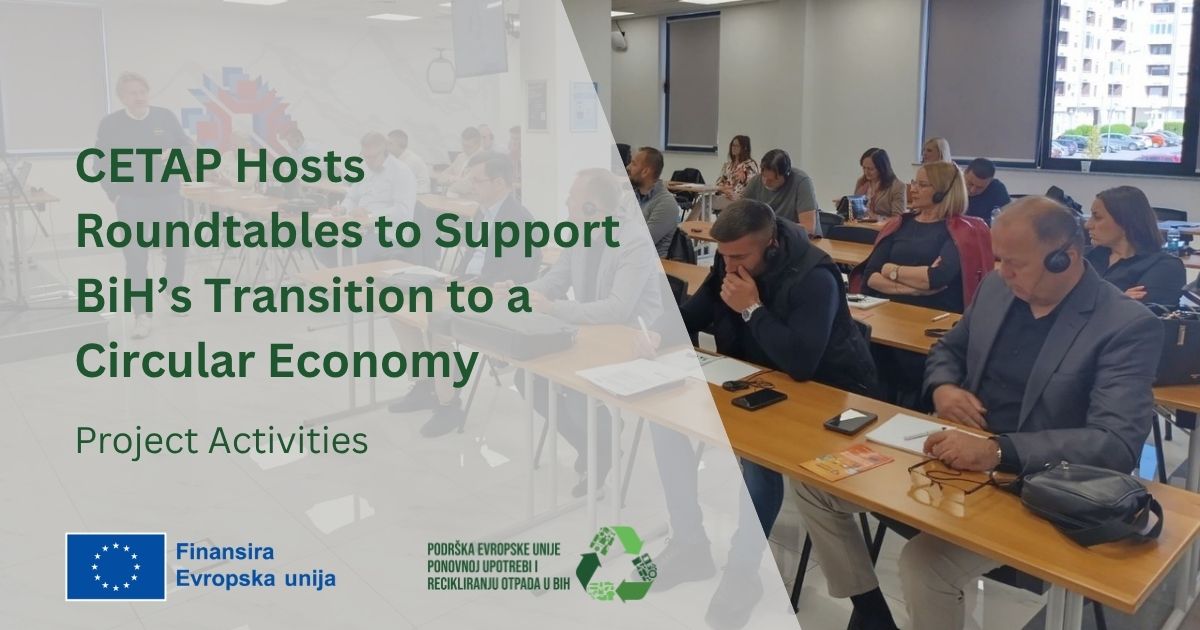
CETAP Hosts Roundtables to Support BiH’s Transition to a Circular Economy
As part of the Circular Economy Technical Assistance Project in Bosnia and Herzegovina, CETAP hosted a series of roundtable events from 28–30 April 2026 in Banja Luka, Tuzla and Sarajevo, bringing together stakeholders to discuss the policy, planning and engagement mechanisms needed to support the country’s transition from a linear to a circular economy. Across the three events, participants explored how circularity can be enabled through stronger economic instruments, more ambitious waste management planning, and meaningful stakeholder engagement.
The first roundtable, held in Banja Luka at the Chamber of Commerce, focused on Policy and Economic Instrument Enablers to Facilitate Transition to Circularity. The session examined how fiscal and market-based instruments can help make circular choices more economically attractive, including VAT differentiation for repair, reuse and remanufactured goods, Extended Producer Responsibility fee modulation, taxes on virgin raw materials, subsidies for secondary materials, and the role of public procurement in creating demand for circular products.
The second roundtable also took place in Banja Luka at the Chamber of Commerce and focused on the Circular Supply Chain within a Circular Economy. Discussions also explored how EU policy architecture can support circular supply chains while avoiding unnecessary complexity, market distortion or disproportionate burdens on businesses and consumers.
The third roundtable took place in Tuzla and focused on Waste Management Planning. Participants discussed how Waste Management Plans can evolve from disposal-focused compliance documents into strategic tools for resource circulation, prevention, reuse, repair and material value retention. The event explored the need to align local and regional planning with EU circular economy frameworks, while also addressing practical delivery challenges such as infrastructure investment, data systems, separate collection, funding models, EPR revenues, digitalisation, and the role of municipalities in supporting more advanced waste and resource management systems.
The fourth roundtable, held in Sarajevo, addressed Stakeholder Engagement Mechanisms to Facilitate Transition from a Linear to a Circular Economy. The discussions focused on how public authorities, producers, SMEs, citizens, social enterprises and other actors can move beyond traditional consultation towards genuine co-creation of circular economy strategies. Participants examined how to craft successful public awareness campaign for waste management, and how these can support measurable changes in production, consumption, reuse and recycling behaviours.
Across all four roundtables, CETAP created space for professional discussion, keynote presentations and group sessions led by CETAP experts. Participants considered important questions around who should bear the costs of transition, how public authorities can balance ambition with practical delivery, how SMEs and citizens can be meaningfully involved, and which policy tools are most likely to deliver results in the short and medium term.
The roundtables highlighted that the transition to a circular economy requires more than technical waste management improvements alone. It depends on coherent policy, credible economic incentives, strong local planning, reliable data, institutional cooperation and public participation.
By connecting these themes across the three events, CETAP supported stakeholders in identifying practical pathways for strengthening circular economy implementation in Bosnia and Herzegovina and aligning national progress with EU circular economy objectives.

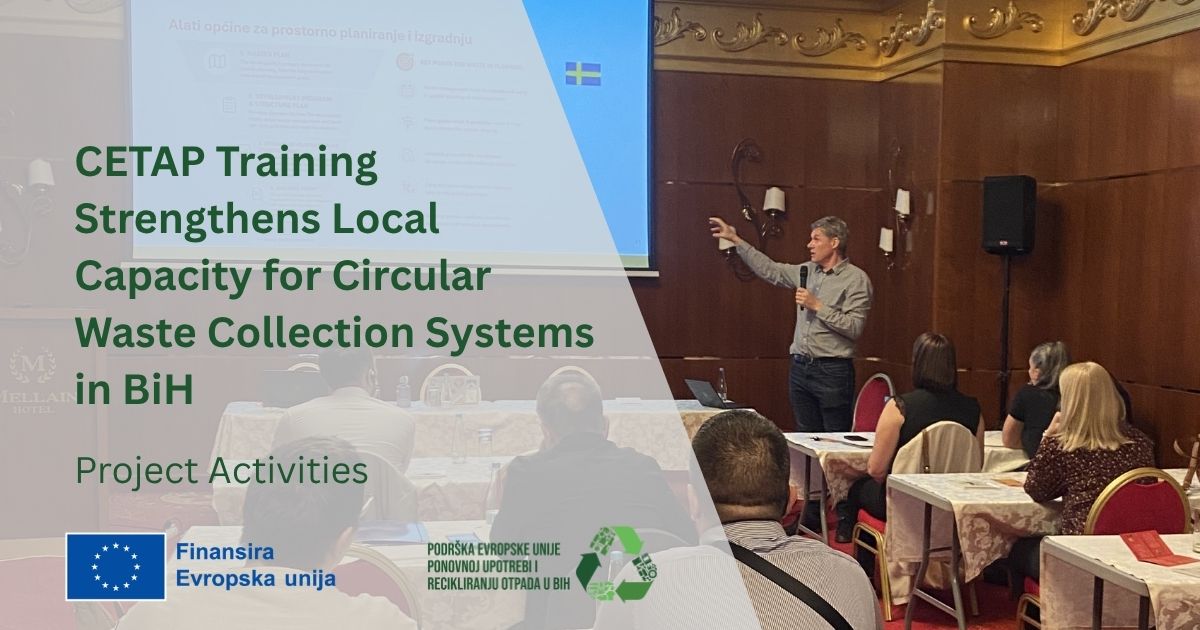
CETAP Training Strengthens Local Capacity for Circular Waste Collection Systems in Bosnia and Herzegovina
As part of the Circular Economy Technical Assistance Project in Bosnia and Herzegovina, CETAP delivered a dedicated training programme on Waste Collection Schemes, Options and Challenges from 4–8 May, bringing together representatives of local authorities, utility companies and relevant stakeholders to support the development of more effective, financially sustainable and circular-oriented waste collection systems.
The training was designed to strengthen practical knowledge around the planning, design and implementation of modern waste collection systems, with a strong focus on local application in Bosnia and Herzegovina. Across the programme, participants explored how municipalities, cantons and utility companies can move beyond traditional waste collection approaches and begin building systems that support waste prevention, separate collection, recycling and long-term circular economy outcomes.
The session opened with “Tools That Change Behaviour: Engagement Mechanisms That Deliver Real Circular Outcomes”, delivered by Scott Crossett, setting the tone for the day by highlighting the role of public engagement, communication and behaviour change in making waste systems work in practice. This was followed by technical sessions led by Harri Moora and Tomas Thernström, who introduced participants to the current waste management situation in Bosnia and Herzegovina, including collection coverage, separate collection challenges and the expectations linked to EU approximation.
A key theme of the training was that successful waste collection systems cannot rely on one single model. Participants examined the different roles of kerbside collection, communal collection systems and staffed recycling centres, and considered how each approach can be adapted for different waste fractions and target groups, including single houses, multi-family housing, rural areas and businesses. Through interactive discussions, participants mapped existing local practices and reflected on which systems are most appropriate for their own communities.
The training also placed strong emphasis on the importance of planning. Participants explored how waste collection systems need to be integrated into municipal planning processes from the earliest stages, including spatial plans, development decisions and building permits. Using examples from Sweden, the training demonstrated how waste assessments can help ensure that collection systems are properly designed before infrastructure is built, and reinforced the responsibility of municipalities to define the permitted systems and technical standards required for effective implementation.
Practical examples from Sweden and Estonia were used throughout the programme to show how different collection systems can be designed, communicated and financed in real-world settings. These examples helped participants consider how international good practice can be adapted to the Bosnia and Herzegovina context, particularly in relation to residual waste, food waste, packaging waste, bulky waste, hazardous waste, e-waste, textiles and garden waste.
By the end of the training, participants had developed a clearer understanding of how waste collection systems can be planned, financed, communicated and adapted to local needs. The training provided not only technical guidance, but also a practical framework for decision-making, helping stakeholders identify realistic improvements that can support Bosnia and Herzegovina’s transition towards a more circular economy.
Through activities such as this, CETAP continues to support institutions, municipalities, utility companies and other stakeholders in building the knowledge, systems and cooperation needed to improve waste management and align with EU circular economy objectives.