

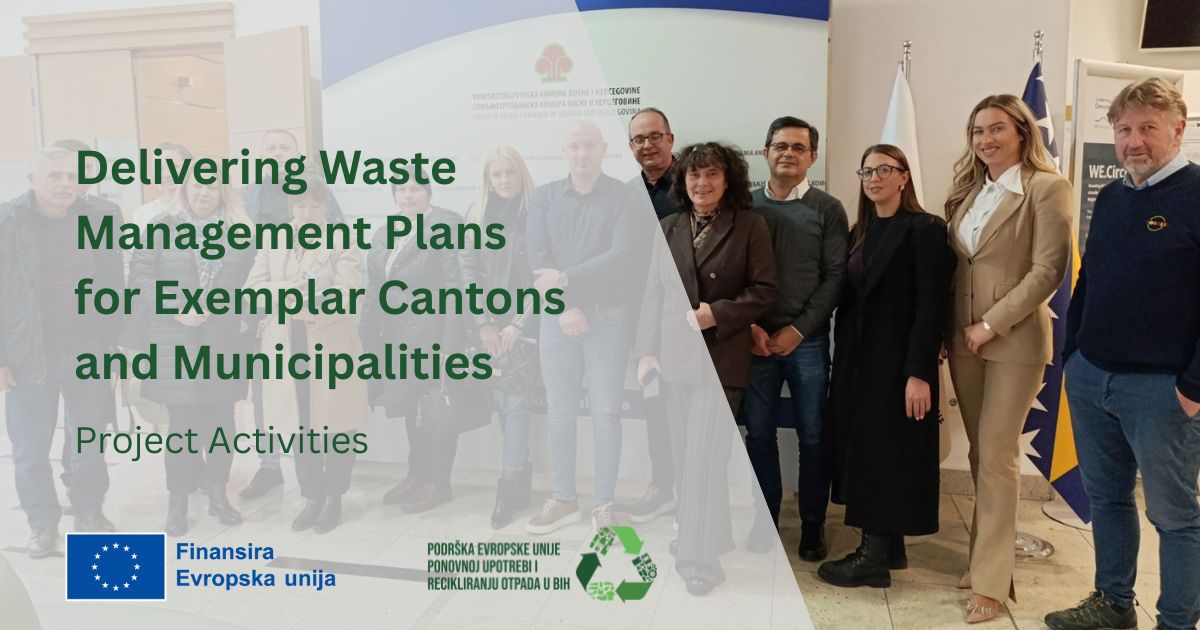
Delivering Waste Management Plans for Exemplar Cantons and Municipalities


Project CETAP is in the process of providing specific technical assistance to support policy development that will favour a circular economy, by promoting and enabling re-use and recycling.
Alongside this the team are supporting further harmonization of the existing country-wide legislation and once completed this will result in an upgraded legal framework governing the waste management - further aligning local entity legislation with the EU Waste Package.
In addition, the agreed scenarios proposed by the Study on Market Potential for the application of circular economy principles in the management of special categories of waste in BiH should be transferred into the municipal and cantonal plans.
The project team will use all of this information to prepare guidelines for strategic planning in the waste sector for cantons and municipalities, and will also develop municipal and cantonal plans for circular special waste management for a specified group of exemplar local government units.
In November the project team developed draft contents for the guideline on strategic planning. This will be presented within the 4th Progress report dated 30th November 2025. The guideline will be prepared during the second quarter of 2026 and the completion of the guidelines will coincide with the delivery of the second series of trainings and stakeholder capacity building.
Also in November the project team had two induction workshops for the exemplar municipalities in Republika Srpska. The events were held in Banja Luka and Sarajevo and were well attend by the exemplar municipalities.
At the workshops the project team discussed the expected outputs and working modalities with the delegates.
The hope now is to have two sessions a month from January 2026 with another one-to-one session planned with the CETAP waste planning expert team for the Republika Srpska in early December 2025.
In terms of waste management planning activities in the Federation, the project team have made agreements with Sarajavo Canton; Herzegovina Neretva Canton; and are awaiting formal agreement from Central Bosnia Canton and Zenica Doboj Canton on specific work activities in those territories. A work plan for these Cantons and associated municipalities is being submitted with the 4th Progress report dated 30th November 2025.
The CETAP Team would like to thank all of our exemplar municipalities and cantons who have are working with us to enable this transition.


Finding Gold in Your Electronic Waste: Turning a Hidden Problem into a Circular Opportunity
Project CETAP — European Week for Waste Reduction (EWWR)
Every year, households and businesses across Bosnia and Herzegovina quietly accumulate a growing mountain of old phones, broken chargers, forgotten laptops, unused cables, damaged hairdryers, and discarded televisions. We rarely think of these items once they stop working—but within this overlooked waste stream lies something far more valuable than most people imagine.
Waste from Electrical and Electronic Equipment (WEEE) also known as electronic waste or e-waste is one of the fastest-growing waste streams globally, and also one of the most resource-rich. Inside even a small mobile phone, you will find tiny but valuable quantities of rare earth elements such as gold, silver, palladium, copper, lithium. These materials are essential for technology, renewable energy systems, electric vehicles, and many sectors that underpin a modern economy.
Yet in Bosnia and Herzegovina—like in many parts of Europe—a significant portion of WEEE never reaches official collection points. Instead, it sits in drawers, is thrown into mixed waste bins, or is handled informally, leading to environmental harm and lost economic potential.
As part of the European Week for Waste Reduction (EWWR), Project CETAP is shining a spotlight on the hidden value in our electronic waste, and how we can unlock it through better habits, stronger systems, and a shift towards a circular economy.
Why is WEEE so important for a circular economy?
Moving from a linear “take–make–dispose” model to a circular system means keeping materials in use for as long as possible. WEEE is one of the clearest examples of why this shift matters.
- Valuable materials are being thrown away
Many electronic devices contain precious metals with surprisingly high market value. For example:
- 1 tonne of used mobile phones contains significantly more gold than 1 tonne of gold ore. 1 ton of ore gets 1g of gold. But you can get the same amount of gold from recycling just 41 mobile phones.
- Recycling aluminium uses 95% less energy than producing new aluminium.
- Copper, lithium, and rare earth elements are essential for green technologies—yet most remain unrecovered.
When WEEE is lost to landfill, these materials must be mined again, contributing to environmental damage, resource depletion, and carbon emissions.
- Improper disposal harms human health and the environment
Electronics contain hazardous substances such as lead, mercury, cadmium, flame retardants, and chemicals that—when not handled properly—can contaminate soil, water, and air. Informal burning or dismantling poses serious risks to communities.
- Recovering materials creates economic opportunities
A well-functioning WEEE collection and recycling system:
- Creates skilled green jobs
- Reduces the need for imported raw materials
- Supports domestic recycling industries
- Helps municipalities comply with EU Waste Package requirements
For Bosnia and Herzegovina, this is not just an environmental issue—it is an economic opportunity.
EWWR: Small actions, big impact
The European Week for Waste Reduction (EWWR) encourages individuals, schools, companies, and institutions across Europe to reduce waste, reuse materials, and improve recycling behaviours. This year’s theme highlights the importance of giving products a new life and preventing valuable resources from being lost.
Project CETAP is contributing to EWWR by raising awareness of the hidden value in WEEE and encouraging citizens to adopt simple, practical habits.
Five actions you can take today
Small steps that help Bosnia and Herzegovina build a circular future.
- Empty your “tech drawer”
We all have one—a drawer full of old phones, USB sticks, remote controls, chargers, or random cables. Clearing it out is the easiest way to start.
- Bring unusable electronics to official collection points
Never place WEEE in the household bin. Approved collection points ensure safe handling and proper recycling. ZEOS is a non-profit in BiH which has collection points all across the country for WEEE, you can find a map of all their recycling points here: https://www.zeos.ba/en/43/pages/21/map-with-containers
- Donate functional devices
Old but working laptops, tablets, and phones can be refurbished and reused by schools, charities, and low-income families.
- Repair instead of replace
Many devices can be fixed cheaply. Repairing extends their life, reduces waste, and supports local repair businesses.
- Choose greener electronics
Look for devices that use recycled materials, have replaceable components, or come with long warranties.
How Project CETAP supports the transition
As Bosnia and Herzegovina works towards EU alignment and a modern circular economy WEEE is a key focus area within Project CETAP. Our work includes:
- Analysing the potential for improved management of special waste streams, including WEEE
- Supporting harmonisation with the EU Waste Package
- Raising national awareness on correct waste handling and circular behaviours
- Engaging municipalities, schools, private sector partners, and citizens
- Delivering a nationwide public awareness campaign launching January 2026
By strengthening systems and educating the public, CETAP helps turn what is currently a waste challenge into an opportunity for sustainable growth.
There is gold in your waste—let’s not throw it away
WEEE is often seen as a burden, but in reality it is one of our most valuable secondary resources. Every old phone, broken toaster, or unused cable contains materials that can be recovered and transformed into something new.
During EWWR, and throughout the months ahead, Project CETAP invites everyone in Bosnia and Herzegovina to take action. Together, we can reduce environmental impact, support a more resource-efficient economy, and unlock the hidden value in the devices we no longer use.
Let’s adopt new habits. Let’s use waste.
A circular future starts with the choices we make today.

Project CETAP Brings Together Experts for Circular Economy Consultation in Doboj
Project CETAP convened its Thematic Working Groups Consultative Workshop at Hotel Park Doboj on the 22–23 October 2025, bringing together leading experts and institutional representatives to review findings from the Study on the Market Potential for the Application of Circular Economy Principles in the Management of Special Categories of Waste in Bosnia and Herzegovina.
This study, prepared under Activity 1.1, assesses opportunities to apply circular-economy principles in managing special waste categories and examines how Bosnia and Herzegovina (BiH) can align with the EU Waste Package and the Green Agenda for the Western Balkans. It identifies the country’s existing strengths and weaknesses while proposing scenarios for reform, innovation, and investment in sustainable waste-management systems.


A Foundation for Change
The report explores:
- Legislative and policy adaptations required for EU alignment.
- Scenarios for improving and expanding Extended Producer Responsibility (EPR) schemes.
- Models for collection and treatment of waste streams such as batteries, end-of-life vehicles, tyres, waste oil, paper and cardboard, construction and demolition waste, and electrical and electronic equipment.
- Adaptation of economic instruments, including new taxes, fees, and funding mechanisms.
- Financing models to support investment in circular-economy infrastructure.
- Concepts for a national waste-exchange platform, defining institutional roles and digital functionality.
The study provides a roadmap for policymakers and industry to strengthen circular practices across sectors while ensuring compliance with European standards.
Two Days of Collaboration and Insight
Over two days, CETAP experts presented the key findings and engaged in open consultation with members of the Thematic Working Group (TWG) — a body comprising representatives from national and entity ministries, local authorities, the private sector, academia, and international organisations. The TWG includes:
Ministry of Foreign Trade and Economic Relations BiH; Ministry of Spatial Planning, Civil Engineering and Ecology of Republika Srpska;
Ministry of Environment and Tourism of the Federation of BiH; Brčko District Department for Spatial Planning and Property Affairs;
Directorate for European Integration BiH; Environmental Funds from both Entities; the World Bank Group; UNDP; BASWA; ALBA Zenica; KIMTEC Eco; ZEOS Eco-system; KJKP “RAD” Sarajevo; the Chambers of Commerce of both Entities; ENOVA; APOSO; Mibral Construction Company; and the Association of Municipalities of Republika Srpska (ALVRS).
Expert Contributions
Day one began with E. Scott Crossett, Team Leader of Project CETAP, introducing the study and outlining the activity objectives. Presentations followed from:
- Harri Moora, Economic Expert – Policy in Circular Economy Transitioning
- Dr Ion Nae Musetoiu, Deputy Team Leader – Regulatory Environment in a Transitioning Economy
- Romano Ruggeri, joining remotely – Role of Regulatory Authorities in the Transition Process
- Elma Kavazović, Waste Management Expert – Stakeholder Mapping for Transition
- Draženko Bjelić, Waste Management Expert – Special Categories of Waste and Their Management
- Maria Krasteva, Waste Management Expert – Moving to Best Practice Models in Waste Management
Each session included structured consultations to gather insights and feedback from the TWG.
Day two featured:
- Harri Moora – Economic Instruments in Circular Economy Transitioning
- Mihail Asenov, Waste Economics Expert – Market Trends and Opportunities
- Simona Ghita, Extended Producer Responsibility Expert – EPR and Special Categories of Waste
- Scott Crossett, Public Awareness Expert – Public Awareness Strategy as a Tool for Transitioning
- Dr Paolo Bacca, Waste Financing Expert – Investment Opportunities and Financing Models for Change
The workshop concluded with Mr Crossett presenting CETAP’s strategic roadmap for transition, thanking all participants for their valuable contributions, and reaffirming the collaborative spirit driving Bosnia and Herzegovina’s circular-economy transformation.
Next Steps
Feedback from the two-day consultation has been documented and will inform the final revisions of the Activity 1.1 Report before publication. The outcomes of this collaborative process will serve as a cornerstone for future policy recommendations, pilot actions, and awareness initiatives implemented through Project CETAP.
Project CETAP extends its sincere appreciation to all members of the Thematic Working Group and partners whose expertise and engagement continue to shape a cleaner, more sustainable, and economically resilient Bosnia and Herzegovina.

From Linear to Circular: Rethinking the Economy for a More Resilient BiH
For decades, Bosnia and Herzegovina’s economy—like much of the world’s—has been built on a linear model: take, make, use, and dispose. It’s a system that has delivered industrial growth, but also one that has left behind growing landfills, wasted resources, and rising environmental costs.
A linear economy has historically helped develop innovation, put money into the economy as it’s increasing our consumerist behaviour - but we realise now that a linear economy is not a sustainable model. The waste we leave behind is not just a missing an opportunity to be transformed into a resource, when it’s not dealt with correctly it becomes costly both environmentally and economically.
Now, as Europe accelerates its transition towards a circular economy, Bosnia and Herzegovina (BiH) stands at a pivotal moment. The shift from linear to circular is not simply an environmental choice—it is a strategic and economic opportunity to strengthen competitiveness, create local jobs, and build long-term resilience.
What Does a Circular Economy Mean for BiH?
A circular economy replaces waste with resourcefulness. It means designing out waste and pollution, keeping products and materials in use for as long as possible, and regenerating natural systems. In practical terms, it means turning yesterday’s waste into tomorrow’s raw material.
For BiH, this transition could bring tangible benefits:
- Reduced import dependency on raw materials by reusing what already exists within our borders.
- New green industries and innovation, from repair and remanufacturing to recycling and eco-design.
- Job creation, particularly in local communities where waste is generated and managed.
- Improved environmental quality—cleaner rivers, greener cities, and healthier living conditions.
These are not abstract ideas. Across Europe, circular models have already delivered measurable results: lower waste generation, new revenue streams, and more stable economies. For BiH, adopting these principles can unlock growth and investment in sustainable sectors, while further aligning with EU environmental standards.
An Economic Shift Rooted in Resilience
In a linear economy, the value of the product disappears the moment it is thrown away. In a circular one, value circulates—retained through reuse, recycling, and smarter design. This makes economies more resilient to shocks such as resource shortages or price fluctuations, while being less dependent on imports.
Bosnia and Herzegovina currently imports a large proportion of its raw materials. By building systems that keep resources in circulation, the country can protect itself against global market volatility. Circular models also encourage innovation and entrepreneurship—offering small and medium-sized enterprises new ways to compete and grow.
Moreover, global investors are increasingly prioritising sustainability. Countries that can demonstrate circularity, transparency, and green credentials are becoming magnets for funding. For BiH, embracing the circular transition means not just protecting the environment, but future-proofing the economy.
Turning Policy into Practice
Circularity requires collaboration: between governments, businesses, academia, and citizens. This is where Project CETAP (Circular Economy Transition and Awareness Programme) plays a key role. Supported by the EU and local partners, CETAP is helping Bosnia and Herzegovina develop the legal, institutional, and cultural foundations for a circular future.
CETAP’s mission is twofold:
- Policy support – helping align national waste and resource management frameworks and Plans with the EU Green Deal, which looks to make the EU become the first climate neutral area by 2050.
- Public awareness and engagement – inspiring citizens, schools, municipalities, and companies to rethink waste as value, through our public awareness campaign which is due to launch in January 2026.
The transition process will not happen overnight but it will happen. And every action—every separated bottle, repaired appliance, or recycled material—builds momentum. CETAP’s approach is rooted in the AKAP model: Awareness, Knowledge, Attitude, and Practice. Awareness begins with understanding why circular principles (reduce, reuse, recycle and recover) matter.
Building a Future That Lasts
Circular economy thinking offers a new vision for Bosnia and Herzegovina—one where progress doesn’t come at the expense of the planet. It challenges the outdated notion that growth and sustainability are opposites, showing instead that smart resource management fuels prosperity.
By rethinking production and consumption, BiH can reduce environmental pressure, stimulate innovation, and strengthen economic sovereignty. More importantly, it can join the growing European community of nations proving that sustainability and success can go hand in hand.
The move from linear to circular is not a step back—it’s a leap forward. A leap towards cleaner industries, more stable jobs, and a future that regenerates rather than depletes. With the right mix of policy, partnership, and public participation, Bosnia and Herzegovina can become a regional leader in circular transformation—showing that resilience begins with rethinking how we use what we have.
About Project CETAP
The Circular Economy Transition and Awareness Programme (CETAP) is an EU-funded initiative supporting Bosnia and Herzegovina’s shift towards a sustainable, resource-efficient economy. By combining policy alignment, stakeholder engagement, and public awareness, CETAP aims to build a greener, more resilient future for all.

Circular Living: How Reuse, Repair, and Resourcefulness Are Already Part of Bosnian Life
Circular Living: How Reuse, Repair, and Resourcefulness Are Already Part of Bosnian Life
For many people across Bosnia and Herzegovina, the principles of circular living are anything but new. They are woven into daily habits, family traditions, and community life. From careful reuse to creative repair, Bosnians have long practised the art of making things last.
Tradition Meets Modern Sustainability
Generations in Bosnia and Herzegovina have grown up with a deep respect for resources: glass jars turned into pantry staples, clothes mended and passed down, leftover food transformed into tomorrow’s meal, and food waste turned into compost.
Today, these values remain strong. In towns and villages, it’s common to see shoes repaired rather than discarded, furniture restored instead of replaced, and garden produce carefully preserved. These are not merely nostalgic customs; they are living examples of circular thinking.
Everyday Reuse and Repair
Walk through a neighbourhood market and you’ll find countless signs of this resourcefulness. From jars refilled with homemade jams and ajvar, to old tools handed down through families, reuse is part of everyday life. Tailors and cobblers—once thought to be disappearing trades—are thriving in many communities, offering affordable repairs that keep clothing and footwear in circulation.
In rural areas, where self-sufficiency remains a point of pride, circular living is even more visible. Composting kitchen scraps, reusing building materials, and repairing farm equipment is the done thing. These practices reduce waste, save money, and keep valuable resources in use.
The Circular Spirit in Cities
Urban centres are seeing a revival of repair and reuse culture too, and looking to use more sustainable materials to make goods. Across Bosnia & Herzegovina, entrepreneurs are creating successful businesses which focus on sustainability and support a circular economy.
In fact one used clothing retail chain has only 2% waste from their sorting process, meaning almost 98% of all incoming garments are re-used or resold.
Fashion brand MAGBAGO based in Bijeljina produces stylish clothing using plant-based and biodegradable materials to drive sustainable fashion. Tamara Djuric, an ecopreneur and founder of MAGBAGO said:
"A more circular economy is essential for Bosnia and Herzegovina because it builds on traditions of resourcefulness and respect for nature that have always been part of our culture. Our grandmothers already had this mindset long ago – saving, reusing, and repurposing everything, from glass jars and bottles to fabrics. I see great potential in simply bringing back that way of thinking, and with it, we can reduce waste, spark innovation, and create healthier communities for the future."
Even digital platforms are joining the movement. Online marketplaces for second-hand goods are booming, giving items a second life and reducing the need for new production.
These ventures and others like them showcase how the people of Bosnia and Herzegovina’s are bringing back a history of ingenuity, restoration and circular practices into a 21st century economy.
A Culture of Resourcefulness
Circular living is about more than recycling bins or government targets. It’s a mindset: valuing what we have, finding new uses for old things, and sharing resources within our communities. Bosnia and Herzegovina has a natural advantage here. The culture of resourcefulness is already embedded in daily life. What’s needed now is support to scale these practices and connect them to modern systems of collection, sorting, and recycling.
Linking Past and Future
As Bosnia and Herzegovina moves toward EU membership and embraces ambitious environmental goals, these long-standing habits can form the foundation for national circular economy strategies. Rather than starting from zero, policymakers and businesses can learn from the ingenuity of everyday people.
Project CETAP (Circular Economy Transition Action Plan) aims to highlight and strengthen this connection. By celebrating local traditions of reuse and repair, and by supporting modern infrastructure for recycling and recovery, CETAP is helping to reflect cultural wisdom into modern policy and practice.
The Opportunity Ahead
Imagine a future where the entire country benefits from this natural circular mindset. Where small-town repair cafes are supported by municipal programmes. Where every city offers collection points for reusable goods. Where schools teach children not just to recycle, but to value materials from the start.
Bosnia and Herzegovina already holds the blueprint for such a future. It’s in the homes where jars are refilled and clothes are mended. It’s in the neighbourhood markets where second-hand goods change hands. And it’s in the collective spirit of a people who know that nothing should be wasted.
Circular living is not a new idea. It’s a way of life. By recognising and expanding these historic traditions, Bosnia and Herzegovina can lead the way toward a truly regenerative, resilient economy—proving that the best solutions for tomorrow may already be found in the wisdom of yesterday.

CETAP’s Second Project Progress Report: Building Momentum
The journey towards a circular economy in Bosnia and Herzegovina (BiH) is well underway. With support from the European Union, the CETAP project continues to drive forward initiatives that strengthen waste management systems, promote reuse and recycling, and build a culture of sustainability.
Covering the period 15th February – 31st May 2025, the second quarterly progress report highlights major milestones, challenges addressed, and our roadmap for the months ahead.
Key Achievements During the Quarter
1. Launch of Thematic Working Groups
During April we held inaugural meetings of CETAP’s four Thematic Working Groups, each addressing a core pillar of the project:
- Legal & Policy
- Technical Solutions
- Education & Awareness
- Economics & Markets
These groups bring together diverse stakeholders from government, industry, academia, and civil society. Their role is to shape and guide decision-making, ensuring every perspective is considered as BiH works towards aligning its systems with EU waste and circular economy legislation.
2. Assessment of Market Potential for Circular Economy Transition
A central focus of this quarter was the continual delivery of Activity 1.1 – assessing the market potential for applying circular economy principles to special categories of waste.
Key steps achieved included:
- Regulatory review: Mapping and translating national legislation to align with the EU Waste Package.
- Stakeholder mapping: Identifying institutions, businesses, universities, and financial actors relevant to the transition.
- Producer mapping: Cataloguing producers of special waste categories (such as WEEE, ELVs, batteries, tyres, and construction & demolition waste).
- Capacity evaluation: Reviewing waste management utilities and companies to understand their readiness to expand recycling and reuse.
- Economic analysis: Draft reports on financial instruments, investor interest, and EPR (Extended Producer Responsibility) schemes.
The final Study on Market Potential will present scenarios for BiH’s transition, offering policy, financial, and operational pathways to circularity.
3. Capacity Building Foundations
The team prepared an introductory training programme for environmental ministries, municipal authorities, and other key stakeholders. Training modules cover:
- EU waste and circular economy policy frameworks
- Benefits and best practices of circular economies
- Steps required to drive institutional and regulatory change
These sessions were delivered throughout June, and aim to build a shared understanding of the circular transition at all levels of governance.
4. Waste Exchange Platform Preparations
Another milestone was progress on the Waste Exchange Platform—a digital solution designed to connect suppliers of secondary raw materials with industries that can reuse them.
Highlights included:
- Engagement with the RS and FBiH Environmental Funds.
- Establishment of a dedicated working group.
- Drafting of technical criteria for secondary raw materials.
- Initial discussions on hosting, governance, and quality control mechanisms.
The platform is envisioned as a cornerstone of a functioning recycling market in BiH, reducing reliance on landfills and illegal dumping.
5. Public Awareness Campaign – First Draft
CETAP’s communication team completed the first draft of a nationwide awareness campaign strategy, scheduled to launch in November 2025.
The campaign will combine digital, broadcast, outdoor, and community actions, highlighting best practices and success stories from across BiH. Its step-by-step approach—shifting citizens from awareness to action—aims to build public ownership of the circular economy agenda.
Communication & Visibility Success
CETAP’s digital presence grew significantly this quarter:
- Our Facebook followers doubled, and if you don’t follow us already on Facebook you can do so here: https://www.facebook.com/ProjectCETAP/
- Our Instagram began to take shape with regular posts published, follow us on Instagram here: https://www.instagram.com/projectcetap/
- Website traffic surged: During April and May our website saw over 25,000 page hits, marking the site as a central hub for information and engagement. You can follow all our updates here: https://cetap.ba/novosti/
This growing online footprint is an encouraging sign ahead of the nationwide awareness campaign. And we would like to thank everyone who is supporting the project!
Looking Ahead
The next reporting period will focus on:
- Finalising the Market Potential Study (Activity 1.1) and presenting findings to the Steering Committee.
- Delivering capacity building training (Activity 1.2) across BiH.
- Drafting legal acts for EU alignment (Activity 1.3) and supporting municipal/cantonal waste management planning (Activity 1.4).
- Advancing the Waste Exchange Platform (Activity 2.1) through technical development and stakeholder coordination.
- Finalising the Public Awareness Campaign Strategy (Activity 3.1) for rollout later this year.
With stakeholder engagement strong and timelines on track, the CETAP project is entering a decisive phase where plans are transformed into action.
Conclusion
The second quarterly report reflects a project gaining real momentum. From regulatory mapping and producer analysis to awareness campaigns and digital engagement, CETAP is laying the groundwork for a more sustainable and resource-efficient Bosnia and Herzegovina.
The transition to a circular economy is complex, requiring legal, economic, technical, and cultural shifts. Yet, as this quarter has shown, the foundations are being steadily built—and the country is moving closer to a future where waste is no longer an endpoint but a valuable resource.

The Hidden Cost of Waste: What Happens to Waste in Bosnia and Herzegovina?
Waste can often be thought of as out of sight, out of mind. Once it leaves our hands and goes into a bin we rarely give it a second thought. But where does it all go? And what is the real cost of this growing mountain of waste to our environment, our health, and our economy?
In Bosnia and Herzegovina, the truth is both alarming and urgent.
The Journey of Waste in BiH
Every day, households, businesses, and industries across the country generate thousands of tonnes of waste. In fact, Bosnia and Herzegovina (BiH) produced 1.2 million tons of municipal waste in 2021, which was a 1.8% increase in the previous year. Each inhabitant of Bosnia and Herzegovina produced an average of 356kg waste - which is the same weight as a fully grown polar bear!
Some of it is collected by municipal services and taken to landfills. Some of it is burned in open spaces. Though the Stockholm Environment Institute (SEI) found that around 25% of all disposed waste ends up in illegal dump sites in BiH. The UNDP found that there were over 1,400 illegal waste disposal sites across the country, these illegal sites are not only unsightly but dangerous—breeding grounds for disease, contamination, and even fire.
And alarmingly in April 2025 only six landfills in Bosnia and Herzegovina met EU standards which means that even the majority of waste which is landfilled legally still fail to meet environmental standards.
These sites often lack impermeable bases, proper gas collection, or leachate treatment. Waste includes broad categories like hazardous or organic materials mixed with general trash, without sorting. This means hazardous substances can seep into the soil and water, releasing toxic gases into the air and polluting ecosystems for decades to come.
Environmental Impact: A Threat to Nature and Climate
Waste that ends up in nature doesn’t just disappear. Plastics break down slowly, a single plastic bottle decomposes over 450 years and turns into microplastics, which can enter the water supply and ultimately the food chain.
Organic waste dumped in landfills emits methane, a greenhouse gas which has a Global Warming Potential (GWP) 80 times more potent than carbon dioxide in the short term. GWP is a measure of how much heat a greenhouse gas traps in the atmosphere.
While chemicals from improperly disposed electronics, batteries, and medical waste can poison animals and pollute water sources.
Bosnia and Herzegovina has a rich biodiversity with around 5,000 vascular plant species documented which is the equivalent to roughly 30% of Balkan endemic flora, making the region vital for plant conservation.
Sutjeska National Park, one of the country’s three national parks, alone supports 2,600 species of vascular plants, including endemic black pines and beech trees—some over 300 years old—in the ancient Perućica forest.
Among fauna, BiH has native brown bears, Balkan chamois, wolves, lynx, wild cats, and over 300 bird species, including golden eagles and peregrine falcons, thriving in protected landscapes
All of this is under direct threat, without strong waste management systems BiH risks irreversible damage to natural heritage.
Economic Impact: Waste is Wasting Money
Poor waste management is not only an environmental issue. It’s an economic one.
Managing illegal dumping, cleaning rivers, and remediating contaminated land costs municipalities millions each year—funds that could be better spent on schools, healthcare, and infrastructure. At the same time, the country is losing out on the economic value of the materials currently being discarded.
Aluminium, plastics, paper, textiles, and organic matter all have potential second lives. Yet, when mixed and buried in landfills, that value is lost. A functioning circular economy could unlock this potential, turning waste into a resource and creating new opportunities for jobs and businesses.
Additionally, in BiH there is no industrial or hazardous waste disposal site in the country, this in turn means that much of the hazardous waste generated in BiH is exported to EU nations for treatment which is a costly and unsustainable approach.
Health Impact: A Silent Crisis
Improperly managed waste directly affects public health. Open burning releases harmful particulates and carcinogens. Leachate from landfills contaminates groundwater used for drinking. Mosquitoes, rats, and other disease vectors thrive in illegal dumpsites.
Communities living near unmanaged waste sites often report higher rates of respiratory illnesses, skin conditions, and gastrointestinal problems. Children are particularly vulnerable. The long-term costs to the healthcare system, productivity, and wellbeing are substantial.
Why Change Is Urgent?
Bosnia and Herzegovina is not alone in facing these challenges. Across the Western Balkans, countries are grappling with the legacy of underinvestment in waste infrastructure. But change is coming.
As part of its path toward EU accession, BiH will need to align with the bloc’s ambitious environmental and circular economy targets. That means reducing landfill dependency, improving recycling rates, and investing in systems that prioritise prevention, reuse, and recovery.
But this isn’t just about compliance. It’s about building a cleaner, fairer, and more sustainable future for everyone.
Advances are already being made and, supported by the European Union, Sweden and the European Bank for Reconstruction and Development (EBRD), a new regional centre in Živinice has been operating since April 2025. It is now the first sanitary landfill with an integrated recycling yard and gas management in Tuzla canton. It serves around 100,000 residents and includes infrastructure to treat leachate and capture methane gas.
The Role of CETAP: Driving the Transition
Project CETAP (Circular Economy Transition Action Plan) was created to support this transformation to reduce waste, improve recycling and help develop a circular economy. By helping local governments, businesses, and communities understand the true cost, and value, of waste, CETAP is laying the groundwork for change.
Through data-driven research, public awareness campaigns, and the development of pilot programmes, CETAP is:
- Identifying key waste streams and opportunities for circularity.
- Supporting local authorities in upgrading waste collection and sorting systems.
- Engaging citizens to reduce, reuse, and recycle.
- Advocating for the investment in circular solutions.
Waste doesn’t have to be a burden. It can be an opportunity.
What Can You Do?
Tackling the waste crisis in BiH requires collective effort. Everyone has a role to play:
- Sort your waste: Separate recyclable materials from general waste. Encourage your local authorities to provide better sorting facilities.
- Avoid single-use plastics: Choose reusable alternatives whenever possible.
- Report illegal dumping: Speak up and demand accountability.
- Support circular businesses: Buy local, repair instead of replace, and look for products made with recycled content.
Small actions, multiplied across communities, create big change.
Toward a Cleaner Bosnia and Herzegovina
The hidden cost of waste is too high to ignore. From polluted rivers and rising health problems to missed economic opportunities, the current system is unsustainable.
But with the right policies, investments, and public support, Bosnia and Herzegovina become a circular economy. One where waste is designed out, materials are reused, and nature is protected.
Project CETAP is proud to be part of this essential transition. Because waste doesn’t just disappear. It shapes our future.

Project CETAP’s third Successful Steering Committee Meeting
On 1st July 2025, the CETAP Project Steering Committee gathered in Sarajevo for its third meeting, bringing together representatives from ministries, municipalities, EU Delegation, and project partners to review progress and set the direction for the months ahead.
Driving Bosnia and Herzegovina’s Circular Economy Transition
The session underscored CETAP’s mission to accelerate Bosnia and Herzegovina’s shift from a linear to a circular economy. Discussions focused on the progress of recent activities, including:
- Introductory workshops in five cities (Bihać, Mostar, Sarajevo, Banja Luka, and Brčko) which engaged more than 130 participants from 90+ organisations. These sessions delivered SWOT analyses, evaluations, and strong momentum for future capacity-building.
- Upcoming training programmes for public and private sector stakeholders, beginning in September 2025, which will guide municipalities in reviewing and developing waste management plans.
- Pilot actions to strengthen the secondary raw materials market, including a new platform for trading recyclables.
Strategic Challenges and the Path Forward
Committee members recognised that transitioning to a circular economy requires more than isolated projects. Stronger policy leadership, inter-ministerial cooperation, and alignment with EU standards will be vital.
To support this, CETAP will analyse institutional and practical barriers and outline a strategic roadmap for Bosnia and Herzegovina.
Building Awareness and Engagement
The project is also advancing communication guidelines to ensure circular economy messages resonate with citizens across all regions. The focus is on creating a unified, relatable message that empowers people to make behavioural changes—supported by the right infrastructure.
Looking Ahead
Key next steps agreed at the meeting include:
- Finalising and sharing reports on training activities, exemplary municipalities, and baseline assessments in July 2025.
- Preparing a study visit to an EU Member State to showcase best practices in waste management and recycling.
- Continuing dialogue with ministries and stakeholders to secure commitment and harmonisation at national level.
A Collective Effort
The meeting closed with recognition of the constructive contributions from all members and a shared commitment to keep driving momentum. CETAP continues to be a platform where institutions, civil society, and international partners collaborate to shape a cleaner, more sustainable future for Bosnia and Herzegovina.
Project CETAP would like to thank all of the Project Steering Committee members for their valued input helping to make the project a success.

What Is a Circular Economy—and Why Does Bosnia and Herzegovina Need One?
Imagine a world where waste doesn’t exist. Where everything we produce, use, and consume has another life, another use, and another purpose. This is the vision of a circular economy—a model that offers not only a solution to the mounting environmental crisis but also a promising pathway to economic resilience. For Bosnia and Herzegovina, the time to embrace this transformation is now.
From Linear to Circular: What Does It Mean?
For many decades, most of the world has followed a linear economic model: take, make, use, and discard. Raw materials are extracted, products are manufactured and consumed, and what's left becomes waste. This model depends on firstly an infinite amount of resources, and secondly, an infinite capacity to absorb endless pollution and waste —both of which, in reality, are finite.
The circular economy flips this logic. Instead of discarding resources, we keep them in use for as long as possible. Products are designed to be reused, repaired, refurbished, or recycled. And by separating organics from our landfill we can put the nutrition from food waste back into the earth.
In practical terms, it means designing clothes that can be recycled, encouraging refillable packaging, turning organic waste into compost, and ensuring electronics can be easily repaired. It's not just about environmental protection; it’s a smarter way of doing business.
Why Does Bosnia and Herzegovina Need a Circular Economy?
Like many countries in the Western Balkans, Bosnia and Herzegovina faces a range of environmental and economic challenges. Waste management systems are outdated. Illegal dumping is widespread. Landfills are overburdened. Meanwhile, industries rely heavily on imported raw materials, creating both economic dependency and vulnerability. A circular economy could address all of this.
Firstly, by repurposing and recycling what was once seen as waste means that less materials are sent to landfills. In 2019, only around 2.2 % of waste was recycled in BiH (the rest was landfilled or illegally dumped), and current figures suggest it’s still between 2-5%. In contrast to this Eurostat states that in 2023, the EU recycled 246 kg per person—which represents 48.0 % of all municipal waste generated.
In BiH much of what could be recovered—plastic, paper, metals, and organics —ends up in landfills or illegally dumped in nature. With the right infrastructure, policies, and public awareness, these valuable materials could be kept in the loop of the economy.
Secondly, a circular economy helps create jobs and foster local innovation. Circular practices like repair, remanufacturing, composting, and material recovery are often more labour-intensive than linear alternatives. That means more opportunities for small businesses, entrepreneurs, and young people looking for meaningful work.
Thirdly, it would strengthen Bosnia and Herzegovina’s economy. By reducing dependence on raw material imports and boosting the use of secondary materials, industries become more resilient to global shocks. Circularity can also make local supply chains more efficient and less wasteful, helping businesses save money while benefiting the environment.
Finally, it's about public health and quality of life. Cleaner environments, fewer illegal dumps, and better air and water quality benefit not just our environment but also the people who inhabit it, whether in a village, town or city. A circular economy supports a more liveable, healthy, and sustainable Bosnia and Herzegovina for all.
Learning from Others, Leading Our Own Way
Countries across Europe are already putting circular economy principles into practice. In the Netherlands, repair cafes and sharing platforms are commonplace. In Slovenia, Mariborm, a once-declining industrial city has become a beacon of circular innovation. The EU's Circular Economy Action Plan is guiding ambitious targets for waste reduction, product design, and green job creation. Bosnia and Herzegovina doesn’t need to start from scratch—but it does need to act.
Project CETAP (Circular Economy Transition Action Plan) exists to help drive that change. By supporting policy reform, piloting circular solutions, and raising public awareness, CETAP is laying the foundation for a new, regenerative economic model. One that serves people and planet.
What Can You Do?
Circular economy isn’t just a matter for policymakers or big businesses. It starts with all of us.
Here are a few simple steps anyone can take:
● Reduce waste: Buy only what you need. Choose products with less packaging. Bring your own bag.
● Reuse and repair: Fix broken items instead of throwing them away. Pass things on instead of throwing them out.
● Recycle correctly: Learn the rules in your municipality and sort your waste accordingly.
● Support local: Choose businesses that prioritise sustainability, use local materials, or offer repair services.
Every small action contributes to a bigger shift. As awareness grows, so too does the momentum for structural change.
A Circular Future for Bosnia and Herzegovina
Transitioning to a circular economy won’t happen overnight. It requires long-term commitment, cross-sector collaboration, and a shift in mindset. But the rewards—economic, environmental, and social—are worth the effort.
Bosnia and Herzegovina stands at a crossroads. With vision and determination, it can become a regional leader in circular economy innovation. Project CETAP is here to support that journey—connecting communities, guiding policy, and inspiring a new way forward.
Because waste is not just a problem to manage. It’s a resource to unlock. And the circular economy is how we turn today’s challenges into tomorrow’s opportunities.
It’s time to bin bad habits and recycle waste.

Team Leader and Deputy Team Leader undertake important mission in April
It was another busy month for the Team Leader and Dr Musetoiu with a hectic round of stakeholder meetings during the two week mission in the month. These stakeholder meetings have been an excellent opportunity to gather data for the Activity 1.1 report on the baseline assessment in BiH in terms of the transitioning process from a linear to a circular economy. It has been really excellent to get engaged with so many professionals from the sector and the meetings have been extremely fruitful and have provided an excellent insight into the important work being done in terms of the progression towards a circular economy in BiH.
This month we had meetings with the following stakeholders in Sarajevo:
Mr Ismar Čeremida, UNDP; Zlata Grabovac and Selma Sokočević both from the Environmental protection sector - Canton Sarajevo department; Mrs Maja Bralović Smith and Mrs Emina Ljubijankic both from the MIBRAL Construction Company; Mr Senaid Bajrić from Euro Asfalt; Mrs Aida Terzić and Mrs Alisa Ibraković both from APOSO; Irem Silajdzic , Sejla Mahmutovic ,Muris Mesetovic, all from the ENOVA Consulting Company who are currently working on the UNDP Project to develop a Federal Waste Management Plan.
It was also nice to be able to catch up with two of the project steering committee members during the mission and Azra Bašić, Federal Ministry of Environment and Tourism; Sanja Grubačić, Ministry of FTER
Our Team Leader also had the pleasure of meeting Sevala Korajcevic, Agency for Statistics of B&H and we look forward to close co-operation with her and her team as we implement the project.
Also it was great to meet Almir Bajtarević, Environment Manager at Hiedelberg Materials, Cement Factory in Kakanj.
While Ion travelled to Mostar to meet with Minister Emil Balav, Cantonal Waste Management Department Representative the Team Leader managed to squeeze in an online meeting with Esma Kreso and Anrea Muharemovic, World Bank Group-Bosnia and Herzegovina prior to departing for the airport.
The project Team Leader would like to thank everyone who has provided their time during April to have these vitally important stakeholder engagement meetings and he looks forward to close collaboration with those stakeholders.