

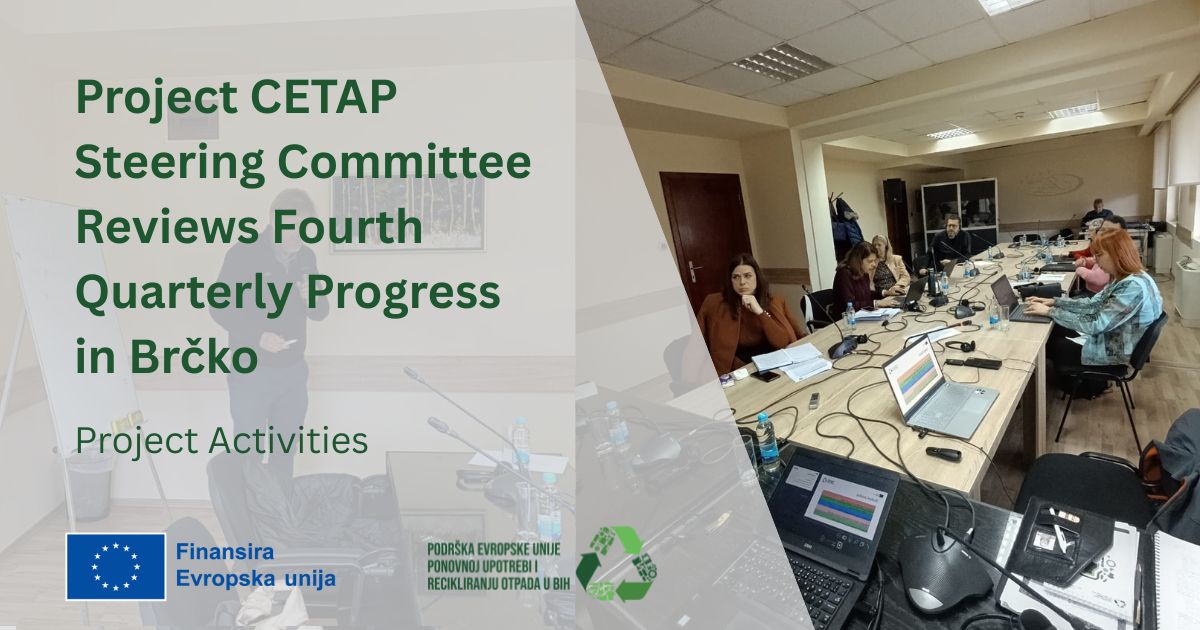
Project CETAP Steering Committee Reviews Fourth Quarterly Progress in Brčko
Project CETAP held its fifth Project Steering Committee (PSC) meeting on 9 December 2025 at Hotel Jelena in Brčko, marking another key milestone in the project’s delivery. The meeting focused on reviewing progress achieved during the fourth reporting period and agreeing priorities for the coming months ahead.
The meeting was formally opened by Mr E. Scott Crossett, the Project Team Leader, and was attended by members of the CETAP team as well as PSC members and observers, including representatives from EU institutions, state and entity ministries, and the Brčko District.
Review of Progress and Reporting Period Activities
The Steering Committee reviewed the productive progress made during the reporting period 1 September – 30 November 2025, including findings from Results-Oriented Monitoring (ROM), and discussed planned activities for 1 December 2025 – 28 February 2026.
A central item was the Draft Study Report, which provides a comprehensive analysis of policy and regulatory frameworks, market analysis, priority waste streams, Extended Producer Responsibility (EPR) schemes, technological innovation, financial and stakeholder assessments, and opportunities to treat waste as a resource. Practical examples, such as container glass, are included to illustrate market potential.
Legislative Alignment and Compliance Work
Significant progress has been made on legislative alignment with the EU waste acquis. The Project Team has reviewed the Draft Law on Waste Management of the Federation of BiH and prepared targeted recommendations to strengthen alignment with EU requirements.
Compliance Tables have been completed for all relevant administrative bodies under the Waste Framework Directive (2008/98/EC). Work is ongoing for the Packaging and Packaging Waste Regulation (EU) 2024/1781 and the WEEE Directive (2012/19/EU), with all remaining compliance work expected to be finalised in the first half of 2026.
Strategic Planning and Local-Level Engagement
A draft content outline has been developed for the Strategic Planning Guideline and Waste Management Plans. As part of this work, workshops with municipalities in Republika Srpska have commenced and work is progressing with 17 exemplar municipalities in total under the programme running through June 2026.
In the Federation of Bosnia and Herzegovina, meetings have been held with selected exemplar cantons, which have submitted formal requests for technical assistance. These cantons are at varying stages of readiness: some require only a review of existing plans, others need updates aligned with planned investments or feasibility studies, while some will require full waste management plans developed from the ground up.
Platforms for Cooperation and Waste Commerce
The Project Steering Committee reviewed progress on the development of both the multi-stakeholder platform and the waste exchange platform.
Meetings have been held with the Chambers of Commerce in the Federation of BiH, Republika Srpska, and Brčko District. While the FBiH and RS chambers already operate suitable digital platforms, the Brčko District chamber will require minor upgrades to meet security standards—support that will be provided by the project. Long-term sustainability was emphasised, with chambers expected to assume responsibility for administration and membership-based financing after project completion.
For the waste exchange platform, both Entity Environment Funds have agreed to host the system within their existing waste information infrastructures, ensuring consistency with EU reporting and data requirements.
Pilot Actions and Public Awareness
During this reporting period, the project delivered three key outputs supporting pilot actions for waste recovery and recycling:
- A waste-category screening report
- A framework for selecting bankable projects
- Project fiches for identified pilot investments
The Project Team is also reviewing data on collected and treated volumes of selected waste streams in close coordination with municipalities and councils. Work continues on EPR schemes and management systems for priority waste streams, including options related to end-of-waste status, glass, and PET.
Progress was also presented on the public awareness campaign, for which the campaign strategy has now been approved. Preparations are underway for launch events scheduled for January 2026.
Mr Crossett closed the meeting by thanking all participants for their continued engagement and constructive contributions. The meeting formally concluded at 15:00.

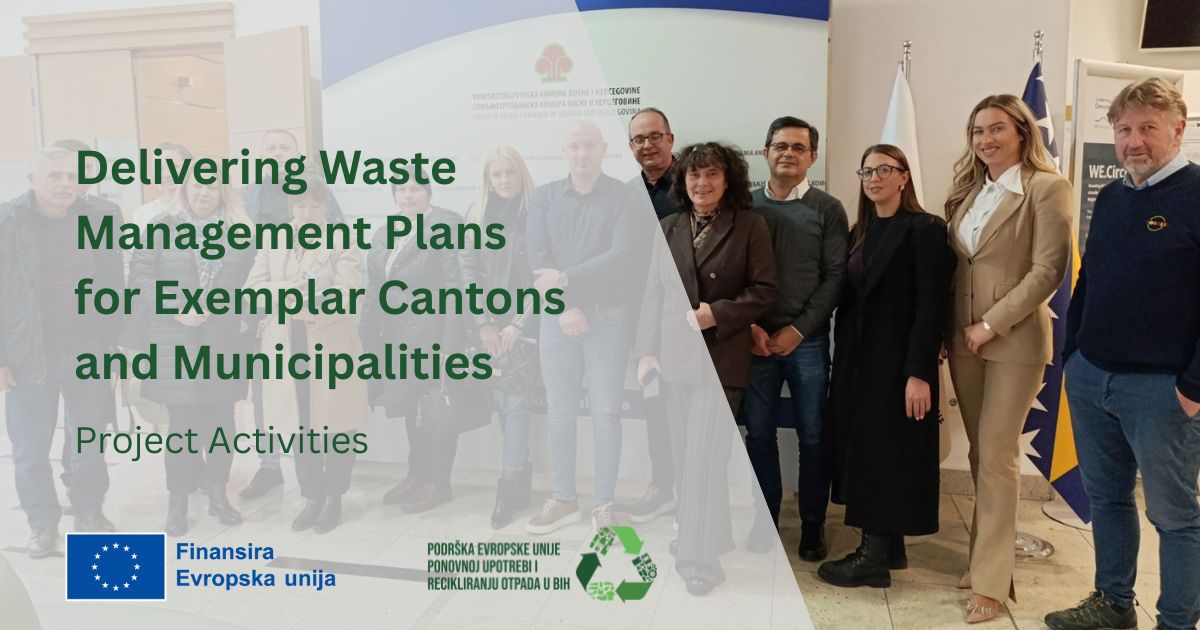
Delivering Waste Management Plans for Exemplar Cantons and Municipalities


Project CETAP is in the process of providing specific technical assistance to support policy development that will favour a circular economy, by promoting and enabling re-use and recycling.
Alongside this the team are supporting further harmonization of the existing country-wide legislation and once completed this will result in an upgraded legal framework governing the waste management - further aligning local entity legislation with the EU Waste Package.
In addition, the agreed scenarios proposed by the Study on Market Potential for the application of circular economy principles in the management of special categories of waste in BiH should be transferred into the municipal and cantonal plans.
The project team will use all of this information to prepare guidelines for strategic planning in the waste sector for cantons and municipalities, and will also develop municipal and cantonal plans for circular special waste management for a specified group of exemplar local government units.
In November the project team developed draft contents for the guideline on strategic planning. This will be presented within the 4th Progress report dated 30th November 2025. The guideline will be prepared during the second quarter of 2026 and the completion of the guidelines will coincide with the delivery of the second series of trainings and stakeholder capacity building.
Also in November the project team had two induction workshops for the exemplar municipalities in Republika Srpska. The events were held in Banja Luka and Sarajevo and were well attend by the exemplar municipalities.
At the workshops the project team discussed the expected outputs and working modalities with the delegates.
The hope now is to have two sessions a month from January 2026 with another one-to-one session planned with the CETAP waste planning expert team for the Republika Srpska in early December 2025.
In terms of waste management planning activities in the Federation, the project team have made agreements with Sarajavo Canton; Herzegovina Neretva Canton; and are awaiting formal agreement from Central Bosnia Canton and Zenica Doboj Canton on specific work activities in those territories. A work plan for these Cantons and associated municipalities is being submitted with the 4th Progress report dated 30th November 2025.
The CETAP Team would like to thank all of our exemplar municipalities and cantons who have are working with us to enable this transition.

Project CETAP Brings Together Experts for Circular Economy Consultation in Doboj
Project CETAP convened its Thematic Working Groups Consultative Workshop at Hotel Park Doboj on the 22–23 October 2025, bringing together leading experts and institutional representatives to review findings from the Study on the Market Potential for the Application of Circular Economy Principles in the Management of Special Categories of Waste in Bosnia and Herzegovina.
This study, prepared under Activity 1.1, assesses opportunities to apply circular-economy principles in managing special waste categories and examines how Bosnia and Herzegovina (BiH) can align with the EU Waste Package and the Green Agenda for the Western Balkans. It identifies the country’s existing strengths and weaknesses while proposing scenarios for reform, innovation, and investment in sustainable waste-management systems.


A Foundation for Change
The report explores:
- Legislative and policy adaptations required for EU alignment.
- Scenarios for improving and expanding Extended Producer Responsibility (EPR) schemes.
- Models for collection and treatment of waste streams such as batteries, end-of-life vehicles, tyres, waste oil, paper and cardboard, construction and demolition waste, and electrical and electronic equipment.
- Adaptation of economic instruments, including new taxes, fees, and funding mechanisms.
- Financing models to support investment in circular-economy infrastructure.
- Concepts for a national waste-exchange platform, defining institutional roles and digital functionality.
The study provides a roadmap for policymakers and industry to strengthen circular practices across sectors while ensuring compliance with European standards.
Two Days of Collaboration and Insight
Over two days, CETAP experts presented the key findings and engaged in open consultation with members of the Thematic Working Group (TWG) — a body comprising representatives from national and entity ministries, local authorities, the private sector, academia, and international organisations. The TWG includes:
Ministry of Foreign Trade and Economic Relations BiH; Ministry of Spatial Planning, Civil Engineering and Ecology of Republika Srpska;
Ministry of Environment and Tourism of the Federation of BiH; Brčko District Department for Spatial Planning and Property Affairs;
Directorate for European Integration BiH; Environmental Funds from both Entities; the World Bank Group; UNDP; BASWA; ALBA Zenica; KIMTEC Eco; ZEOS Eco-system; KJKP “RAD” Sarajevo; the Chambers of Commerce of both Entities; ENOVA; APOSO; Mibral Construction Company; and the Association of Municipalities of Republika Srpska (ALVRS).
Expert Contributions
Day one began with E. Scott Crossett, Team Leader of Project CETAP, introducing the study and outlining the activity objectives. Presentations followed from:
- Harri Moora, Economic Expert – Policy in Circular Economy Transitioning
- Dr Ion Nae Musetoiu, Deputy Team Leader – Regulatory Environment in a Transitioning Economy
- Romano Ruggeri, joining remotely – Role of Regulatory Authorities in the Transition Process
- Elma Kavazović, Waste Management Expert – Stakeholder Mapping for Transition
- Draženko Bjelić, Waste Management Expert – Special Categories of Waste and Their Management
- Maria Krasteva, Waste Management Expert – Moving to Best Practice Models in Waste Management
Each session included structured consultations to gather insights and feedback from the TWG.
Day two featured:
- Harri Moora – Economic Instruments in Circular Economy Transitioning
- Mihail Asenov, Waste Economics Expert – Market Trends and Opportunities
- Simona Ghita, Extended Producer Responsibility Expert – EPR and Special Categories of Waste
- Scott Crossett, Public Awareness Expert – Public Awareness Strategy as a Tool for Transitioning
- Dr Paolo Bacca, Waste Financing Expert – Investment Opportunities and Financing Models for Change
The workshop concluded with Mr Crossett presenting CETAP’s strategic roadmap for transition, thanking all participants for their valuable contributions, and reaffirming the collaborative spirit driving Bosnia and Herzegovina’s circular-economy transformation.
Next Steps
Feedback from the two-day consultation has been documented and will inform the final revisions of the Activity 1.1 Report before publication. The outcomes of this collaborative process will serve as a cornerstone for future policy recommendations, pilot actions, and awareness initiatives implemented through Project CETAP.
Project CETAP extends its sincere appreciation to all members of the Thematic Working Group and partners whose expertise and engagement continue to shape a cleaner, more sustainable, and economically resilient Bosnia and Herzegovina.

CETAP’s Second Project Progress Report: Building Momentum
The journey towards a circular economy in Bosnia and Herzegovina (BiH) is well underway. With support from the European Union, the CETAP project continues to drive forward initiatives that strengthen waste management systems, promote reuse and recycling, and build a culture of sustainability.
Covering the period 15th February – 31st May 2025, the second quarterly progress report highlights major milestones, challenges addressed, and our roadmap for the months ahead.
Key Achievements During the Quarter
1. Launch of Thematic Working Groups
During April we held inaugural meetings of CETAP’s four Thematic Working Groups, each addressing a core pillar of the project:
- Legal & Policy
- Technical Solutions
- Education & Awareness
- Economics & Markets
These groups bring together diverse stakeholders from government, industry, academia, and civil society. Their role is to shape and guide decision-making, ensuring every perspective is considered as BiH works towards aligning its systems with EU waste and circular economy legislation.
2. Assessment of Market Potential for Circular Economy Transition
A central focus of this quarter was the continual delivery of Activity 1.1 – assessing the market potential for applying circular economy principles to special categories of waste.
Key steps achieved included:
- Regulatory review: Mapping and translating national legislation to align with the EU Waste Package.
- Stakeholder mapping: Identifying institutions, businesses, universities, and financial actors relevant to the transition.
- Producer mapping: Cataloguing producers of special waste categories (such as WEEE, ELVs, batteries, tyres, and construction & demolition waste).
- Capacity evaluation: Reviewing waste management utilities and companies to understand their readiness to expand recycling and reuse.
- Economic analysis: Draft reports on financial instruments, investor interest, and EPR (Extended Producer Responsibility) schemes.
The final Study on Market Potential will present scenarios for BiH’s transition, offering policy, financial, and operational pathways to circularity.
3. Capacity Building Foundations
The team prepared an introductory training programme for environmental ministries, municipal authorities, and other key stakeholders. Training modules cover:
- EU waste and circular economy policy frameworks
- Benefits and best practices of circular economies
- Steps required to drive institutional and regulatory change
These sessions were delivered throughout June, and aim to build a shared understanding of the circular transition at all levels of governance.
4. Waste Exchange Platform Preparations
Another milestone was progress on the Waste Exchange Platform—a digital solution designed to connect suppliers of secondary raw materials with industries that can reuse them.
Highlights included:
- Engagement with the RS and FBiH Environmental Funds.
- Establishment of a dedicated working group.
- Drafting of technical criteria for secondary raw materials.
- Initial discussions on hosting, governance, and quality control mechanisms.
The platform is envisioned as a cornerstone of a functioning recycling market in BiH, reducing reliance on landfills and illegal dumping.
5. Public Awareness Campaign – First Draft
CETAP’s communication team completed the first draft of a nationwide awareness campaign strategy, scheduled to launch in November 2025.
The campaign will combine digital, broadcast, outdoor, and community actions, highlighting best practices and success stories from across BiH. Its step-by-step approach—shifting citizens from awareness to action—aims to build public ownership of the circular economy agenda.
Communication & Visibility Success
CETAP’s digital presence grew significantly this quarter:
- Our Facebook followers doubled, and if you don’t follow us already on Facebook you can do so here: https://www.facebook.com/ProjectCETAP/
- Our Instagram began to take shape with regular posts published, follow us on Instagram here: https://www.instagram.com/projectcetap/
- Website traffic surged: During April and May our website saw over 25,000 page hits, marking the site as a central hub for information and engagement. You can follow all our updates here: https://cetap.ba/novosti/
This growing online footprint is an encouraging sign ahead of the nationwide awareness campaign. And we would like to thank everyone who is supporting the project!
Looking Ahead
The next reporting period will focus on:
- Finalising the Market Potential Study (Activity 1.1) and presenting findings to the Steering Committee.
- Delivering capacity building training (Activity 1.2) across BiH.
- Drafting legal acts for EU alignment (Activity 1.3) and supporting municipal/cantonal waste management planning (Activity 1.4).
- Advancing the Waste Exchange Platform (Activity 2.1) through technical development and stakeholder coordination.
- Finalising the Public Awareness Campaign Strategy (Activity 3.1) for rollout later this year.
With stakeholder engagement strong and timelines on track, the CETAP project is entering a decisive phase where plans are transformed into action.
Conclusion
The second quarterly report reflects a project gaining real momentum. From regulatory mapping and producer analysis to awareness campaigns and digital engagement, CETAP is laying the groundwork for a more sustainable and resource-efficient Bosnia and Herzegovina.
The transition to a circular economy is complex, requiring legal, economic, technical, and cultural shifts. Yet, as this quarter has shown, the foundations are being steadily built—and the country is moving closer to a future where waste is no longer an endpoint but a valuable resource.

Project CETAP’s third Successful Steering Committee Meeting
On 1st July 2025, the CETAP Project Steering Committee gathered in Sarajevo for its third meeting, bringing together representatives from ministries, municipalities, EU Delegation, and project partners to review progress and set the direction for the months ahead.
Driving Bosnia and Herzegovina’s Circular Economy Transition
The session underscored CETAP’s mission to accelerate Bosnia and Herzegovina’s shift from a linear to a circular economy. Discussions focused on the progress of recent activities, including:
- Introductory workshops in five cities (Bihać, Mostar, Sarajevo, Banja Luka, and Brčko) which engaged more than 130 participants from 90+ organisations. These sessions delivered SWOT analyses, evaluations, and strong momentum for future capacity-building.
- Upcoming training programmes for public and private sector stakeholders, beginning in September 2025, which will guide municipalities in reviewing and developing waste management plans.
- Pilot actions to strengthen the secondary raw materials market, including a new platform for trading recyclables.
Strategic Challenges and the Path Forward
Committee members recognised that transitioning to a circular economy requires more than isolated projects. Stronger policy leadership, inter-ministerial cooperation, and alignment with EU standards will be vital.
To support this, CETAP will analyse institutional and practical barriers and outline a strategic roadmap for Bosnia and Herzegovina.
Building Awareness and Engagement
The project is also advancing communication guidelines to ensure circular economy messages resonate with citizens across all regions. The focus is on creating a unified, relatable message that empowers people to make behavioural changes—supported by the right infrastructure.
Looking Ahead
Key next steps agreed at the meeting include:
- Finalising and sharing reports on training activities, exemplary municipalities, and baseline assessments in July 2025.
- Preparing a study visit to an EU Member State to showcase best practices in waste management and recycling.
- Continuing dialogue with ministries and stakeholders to secure commitment and harmonisation at national level.
A Collective Effort
The meeting closed with recognition of the constructive contributions from all members and a shared commitment to keep driving momentum. CETAP continues to be a platform where institutions, civil society, and international partners collaborate to shape a cleaner, more sustainable future for Bosnia and Herzegovina.
Project CETAP would like to thank all of the Project Steering Committee members for their valued input helping to make the project a success.

Team Leader and Deputy Team Leader undertake important mission in April
It was another busy month for the Team Leader and Dr Musetoiu with a hectic round of stakeholder meetings during the two week mission in the month. These stakeholder meetings have been an excellent opportunity to gather data for the Activity 1.1 report on the baseline assessment in BiH in terms of the transitioning process from a linear to a circular economy. It has been really excellent to get engaged with so many professionals from the sector and the meetings have been extremely fruitful and have provided an excellent insight into the important work being done in terms of the progression towards a circular economy in BiH.
This month we had meetings with the following stakeholders in Sarajevo:
Mr Ismar Čeremida, UNDP; Zlata Grabovac and Selma Sokočević both from the Environmental protection sector - Canton Sarajevo department; Mrs Maja Bralović Smith and Mrs Emina Ljubijankic both from the MIBRAL Construction Company; Mr Senaid Bajrić from Euro Asfalt; Mrs Aida Terzić and Mrs Alisa Ibraković both from APOSO; Irem Silajdzic , Sejla Mahmutovic ,Muris Mesetovic, all from the ENOVA Consulting Company who are currently working on the UNDP Project to develop a Federal Waste Management Plan.
It was also nice to be able to catch up with two of the project steering committee members during the mission and Azra Bašić, Federal Ministry of Environment and Tourism; Sanja Grubačić, Ministry of FTER
Our Team Leader also had the pleasure of meeting Sevala Korajcevic, Agency for Statistics of B&H and we look forward to close co-operation with her and her team as we implement the project.
Also it was great to meet Almir Bajtarević, Environment Manager at Hiedelberg Materials, Cement Factory in Kakanj.
While Ion travelled to Mostar to meet with Minister Emil Balav, Cantonal Waste Management Department Representative the Team Leader managed to squeeze in an online meeting with Esma Kreso and Anrea Muharemovic, World Bank Group-Bosnia and Herzegovina prior to departing for the airport.
The project Team Leader would like to thank everyone who has provided their time during April to have these vitally important stakeholder engagement meetings and he looks forward to close collaboration with those stakeholders.
1st Project Progress Report: Laying the Foundations for a Circular Economy in Bosnia and Herzegovina
The CETAP project, funded by the European Union and implemented by COWI in partnership with SEI and UBA, has made strong strides in its mission to support Bosnia and Herzegovina’s transition towards a circular economy. The project aims to improve the recovery of materials from waste through separate collection, reuse, and recycling—placing sustainability at the heart of waste management reforms.
Key Achievements in the First Quarter
During the reporting period from November 2024 to February 2025, the project team focused on delivering Sub-Activity 1.1: a comprehensive assessment of market potential for applying circular economy principles to special waste categories.
Key milestones include:
- Stakeholder Mapping & Engagement: Many meetings were held with government bodies, municipal utilities, recycling operators, and EPR scheme coordinators across both entities and Brčko District. This engagement has been vital for understanding the current landscape and building cooperation.
- Policy and Regulatory Review: A full review of relevant waste legislation across the Federation of BiH, Republika Srpska, and Brčko District is underway. The findings will shape future legal reforms to align with the EU Waste Package and Green Agenda for the Western Balkans.
- Data Collection on Special Waste Streams: The team has mapped producers of special categories of waste (e.g. WEEE, tyres, oils, construction and demolition waste), and started collecting quantity and treatment data, with requests issued to Environmental Funds for input.
- Formation of Thematic Working Groups: Expert-led working groups are being launched to steer actions in legal alignment, economic modelling, technical planning, and public awareness. These groups will begin formal meetings in March.
What Comes Next
With the groundwork laid, CETAP is now moving toward:
- Finalising the Study on Market Potential for Circular Economy Application
- Launching capacity building programmes for stakeholders at all levels
- Initiating the drafting of new legal frameworks and supporting municipal-level planning
- Preparing for the development of a national waste exchange platform, with technical input from Croatian experts
- Designing a nationwide public awareness campaign to engage citizens on reuse, recovery, and recycling
Sustainable Waste Management Starts with Strategy
CETAP is not just a technical assistance project—it’s a catalyst for systemic change. By embedding circular economy principles into the country’s policy, infrastructure, and public mindset, Bosnia and Herzegovina is taking a bold step toward a greener, more resource-efficient future.
For ongoing updates and announcements, visit www.cetap.ba/en/news.
2nd Project Steering Committee Meeting
March marked a significant milestone on the Circular Economy project in Bosnia & Hercegovina as we hosted the second Project Steering Committee meeting. It has been a really productive period on the project and marks the start of an intensive period of activity in the run up to the summer period. We now turn our attention to the Implementation phase and the first activities of the project.
The steering committee meeting was held in Sarajevo and it was really good to meet the members of the committee again and go through the outputs of the reporting period together. The meeting is also an opportunity for the members of the committee to get an insight into the implementation plans in a bit more detail than was outlined on the implementation methodology.
The steering committee are really supportive of the project and its aims and objectives. They all have a clear understanding of what the expectation level is from this technical assistance project and how they can optimise the benefits from it for Bosnia and Herzegovina.
We have a three-monthly cycle of project steering committee meetings The team are really looking forward to working with them over the course of the project lifetime. The next meeting is planned for the end of June 2025 and this will work in well with the completion of the first activities of the implementation phase.
Driving Circular Change: Financial and Legislative Insights from March 2025 Mission
As Bosnia and Herzegovina continues its transition toward a circular economy, the CETAP project is building the knowledge, partnerships and policy groundwork needed to reform waste management across the country. In March 2025, financial and legislative expert Mihail Asenov led a mission to deepen the project's understanding of economic structures, policy alignment, and the role of extended producer responsibility (EPR) in driving change.
Bridging Policy, Practice and the Market
The mission, carried out between 9–20 March, engaged with over a dozen stakeholders across Sarajevo, Banja Luka, and Brčko District, including ministries, environmental funds, producer responsibility organisations (PROs), and private sector actors. These meetings revealed critical opportunities and obstacles in aligning Bosnia and Herzegovina’s systems with the EU Waste Package and the Green Agenda for the Western Balkans.
Key Highlights and Learnings
- Waste Exchange Platform Development: Consultations with the Environmental Protection Funds of both entities confirmed institutional interest in hosting a national waste exchange platform. Discussions covered technical, financial, and governance considerations.
- EPR System Fragmentation: The mission highlighted inconsistencies in EPR fee collection, reporting, and enforcement. Stakeholders identified a need for regulatory harmonisation, improved oversight, and greater transparency—especially in the packaging and e-waste sectors.
- Market Realities and Data Gaps: Many PROs reported underfunding, unclear legal responsibilities, and significant gaps in data quality and waste tracking. Several called for reforms to ensure open tendering and the inclusion of more private collectors.
- Government Engagement: Ministries from both the Federation and Republika Srpska expressed commitment to legislative alignment with EU directives. However, capacity building and clearer implementation pathways are still needed.
- Chambers and Collaboration: The Chamber of Economy of FBiH welcomed the opportunity to play a coordinating role in circular economy planning, especially around awareness raising and training.
Next Steps
Based on the mission’s outcomes, the following actions are underway:
- Formation of a Finance, Economy and Market Working Group by the end of April.
- Drafting of the Study on Market Potential for circular economy transition.
- Development of coordinated plans for EPR reform and economic instrument alignment.
- Preparation of the next mission, scheduled for late April.
Laying the Economic Foundation for Circularity
This mission provided essential insight into the economic and legal conditions underpinning Bosnia and Herzegovina’s circular economy potential. As the CETAP project progresses, these findings will inform not only strategic planning but also practical recommendations for building a robust, harmonised, and financially viable system for waste recovery and recycling.
To learn more and follow the progress of CETAP, visit www.cetap.ba/en/news.
Strengthening Circular Economy Insights Across Bosnia and Herzegovina: Highlights from the March 2025 Mission
The EU-funded CETAP project continues to advance Bosnia and Herzegovina’s journey toward a circular economy. As part of this momentum, an expert mission was conducted in March 2025 across several regions, providing invaluable on-the-ground insights into local waste management practices, infrastructure, and stakeholder engagement.
On-the-Ground Engagement Across the Federation and Republika Srpska
Led by international expert Maria Krasteva from Environment Agency Austria, the mission covered key municipalities in both entities, including Canton 10 (Livno), Tuzla, Zenica, Travnik, and Banja Luka. The objective was to assess the current state of waste generation, collection, and treatment—with a focus on special categories such as e-waste, used tyres, batteries, and End-of-Life Vehicles (EoLVs).
Site visits and interviews were conducted with:
- Public Utility Companies (PUCs) in Livno, Tuzla, Travnik, and Zenica
- Private scrap and recycling operators
- Metal reprocessing firms (e.g., Cibos)
- Local environmental authorities
- The Chamber of Commerce of Republika Srpska
- Regional landfill and sorting facilities in Sarajevo
Key Findings
- Varying Levels of Readiness: The mission revealed significant regional differences in capacity and infrastructure for waste collection and recycling. Some cantons have initiated dual collection systems, while others still rely heavily on mixed waste disposal.
- Challenges in Special Waste Categories: Consistent issues were raised around handling of EoLVs, Waste Electrical and Electronic Equipment (WEEE), and tyres—largely due to fragmented responsibilities, insufficient enforcement, and lack of data.
- Resource Constraints and Investment Needs: Across both public and private stakeholders, a common concern was the limited financial and technical capacity to implement advanced waste recovery solutions without external support.
- Strong Willingness to Cooperate: Encouragingly, all stakeholders expressed readiness to participate in technical working groups and to align their strategies with CETAP’s goals.
Looking Ahead
The mission outcomes will directly inform the development of the Study on the Market Potential for Circular Economy Application, feeding into the assessment of market potential for circular economy principles. Follow-up actions include:
- Establishment of a dedicated Technical Working Group by the end of April.
- Finalisation of activity plans to support legal harmonisation and local implementation.
- Continued collaboration on waste data collection and planning support for municipal partner.
Collaboration in Action
CETAP’s hands-on approach—combining policy planning with deep community engagement—is already proving instrumental in tailoring solutions to Bosnia and Herzegovina’s unique context. The March mission reinforced the need for integrated action across government levels, industry, and civil society to make the circular economy a functional reality.
To stay updated on future activities and reports, visit www.cetap.ba/en/news.