

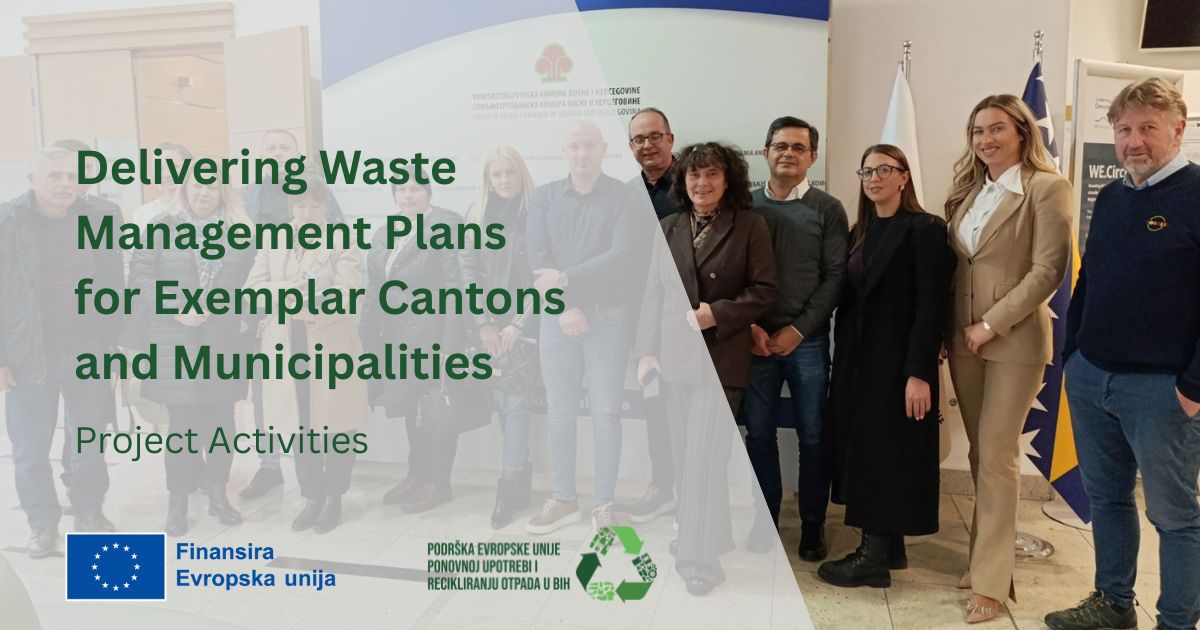
Delivering Waste Management Plans for Exemplar Cantons and Municipalities


Project CETAP is in the process of providing specific technical assistance to support policy development that will favour a circular economy, by promoting and enabling re-use and recycling.
Alongside this the team are supporting further harmonization of the existing country-wide legislation and once completed this will result in an upgraded legal framework governing the waste management - further aligning local entity legislation with the EU Waste Package.
In addition, the agreed scenarios proposed by the Study on Market Potential for the application of circular economy principles in the management of special categories of waste in BiH should be transferred into the municipal and cantonal plans.
The project team will use all of this information to prepare guidelines for strategic planning in the waste sector for cantons and municipalities, and will also develop municipal and cantonal plans for circular special waste management for a specified group of exemplar local government units.
In November the project team developed draft contents for the guideline on strategic planning. This will be presented within the 4th Progress report dated 30th November 2025. The guideline will be prepared during the second quarter of 2026 and the completion of the guidelines will coincide with the delivery of the second series of trainings and stakeholder capacity building.
Also in November the project team had two induction workshops for the exemplar municipalities in Republika Srpska. The events were held in Banja Luka and Sarajevo and were well attend by the exemplar municipalities.
At the workshops the project team discussed the expected outputs and working modalities with the delegates.
The hope now is to have two sessions a month from January 2026 with another one-to-one session planned with the CETAP waste planning expert team for the Republika Srpska in early December 2025.
In terms of waste management planning activities in the Federation, the project team have made agreements with Sarajavo Canton; Herzegovina Neretva Canton; and are awaiting formal agreement from Central Bosnia Canton and Zenica Doboj Canton on specific work activities in those territories. A work plan for these Cantons and associated municipalities is being submitted with the 4th Progress report dated 30th November 2025.
The CETAP Team would like to thank all of our exemplar municipalities and cantons who have are working with us to enable this transition.


Finding Gold in Your Electronic Waste: Turning a Hidden Problem into a Circular Opportunity
Project CETAP — European Week for Waste Reduction (EWWR)
Every year, households and businesses across Bosnia and Herzegovina quietly accumulate a growing mountain of old phones, broken chargers, forgotten laptops, unused cables, damaged hairdryers, and discarded televisions. We rarely think of these items once they stop working—but within this overlooked waste stream lies something far more valuable than most people imagine.
Waste from Electrical and Electronic Equipment (WEEE) also known as electronic waste or e-waste is one of the fastest-growing waste streams globally, and also one of the most resource-rich. Inside even a small mobile phone, you will find tiny but valuable quantities of rare earth elements such as gold, silver, palladium, copper, lithium. These materials are essential for technology, renewable energy systems, electric vehicles, and many sectors that underpin a modern economy.
Yet in Bosnia and Herzegovina—like in many parts of Europe—a significant portion of WEEE never reaches official collection points. Instead, it sits in drawers, is thrown into mixed waste bins, or is handled informally, leading to environmental harm and lost economic potential.
As part of the European Week for Waste Reduction (EWWR), Project CETAP is shining a spotlight on the hidden value in our electronic waste, and how we can unlock it through better habits, stronger systems, and a shift towards a circular economy.
Why is WEEE so important for a circular economy?
Moving from a linear “take–make–dispose” model to a circular system means keeping materials in use for as long as possible. WEEE is one of the clearest examples of why this shift matters.
- Valuable materials are being thrown away
Many electronic devices contain precious metals with surprisingly high market value. For example:
- 1 tonne of used mobile phones contains significantly more gold than 1 tonne of gold ore. 1 ton of ore gets 1g of gold. But you can get the same amount of gold from recycling just 41 mobile phones.
- Recycling aluminium uses 95% less energy than producing new aluminium.
- Copper, lithium, and rare earth elements are essential for green technologies—yet most remain unrecovered.
When WEEE is lost to landfill, these materials must be mined again, contributing to environmental damage, resource depletion, and carbon emissions.
- Improper disposal harms human health and the environment
Electronics contain hazardous substances such as lead, mercury, cadmium, flame retardants, and chemicals that—when not handled properly—can contaminate soil, water, and air. Informal burning or dismantling poses serious risks to communities.
- Recovering materials creates economic opportunities
A well-functioning WEEE collection and recycling system:
- Creates skilled green jobs
- Reduces the need for imported raw materials
- Supports domestic recycling industries
- Helps municipalities comply with EU Waste Package requirements
For Bosnia and Herzegovina, this is not just an environmental issue—it is an economic opportunity.
EWWR: Small actions, big impact
The European Week for Waste Reduction (EWWR) encourages individuals, schools, companies, and institutions across Europe to reduce waste, reuse materials, and improve recycling behaviours. This year’s theme highlights the importance of giving products a new life and preventing valuable resources from being lost.
Project CETAP is contributing to EWWR by raising awareness of the hidden value in WEEE and encouraging citizens to adopt simple, practical habits.
Five actions you can take today
Small steps that help Bosnia and Herzegovina build a circular future.
- Empty your “tech drawer”
We all have one—a drawer full of old phones, USB sticks, remote controls, chargers, or random cables. Clearing it out is the easiest way to start.
- Bring unusable electronics to official collection points
Never place WEEE in the household bin. Approved collection points ensure safe handling and proper recycling. ZEOS is a non-profit in BiH which has collection points all across the country for WEEE, you can find a map of all their recycling points here: https://www.zeos.ba/en/43/pages/21/map-with-containers
- Donate functional devices
Old but working laptops, tablets, and phones can be refurbished and reused by schools, charities, and low-income families.
- Repair instead of replace
Many devices can be fixed cheaply. Repairing extends their life, reduces waste, and supports local repair businesses.
- Choose greener electronics
Look for devices that use recycled materials, have replaceable components, or come with long warranties.
How Project CETAP supports the transition
As Bosnia and Herzegovina works towards EU alignment and a modern circular economy WEEE is a key focus area within Project CETAP. Our work includes:
- Analysing the potential for improved management of special waste streams, including WEEE
- Supporting harmonisation with the EU Waste Package
- Raising national awareness on correct waste handling and circular behaviours
- Engaging municipalities, schools, private sector partners, and citizens
- Delivering a nationwide public awareness campaign launching January 2026
By strengthening systems and educating the public, CETAP helps turn what is currently a waste challenge into an opportunity for sustainable growth.
There is gold in your waste—let’s not throw it away
WEEE is often seen as a burden, but in reality it is one of our most valuable secondary resources. Every old phone, broken toaster, or unused cable contains materials that can be recovered and transformed into something new.
During EWWR, and throughout the months ahead, Project CETAP invites everyone in Bosnia and Herzegovina to take action. Together, we can reduce environmental impact, support a more resource-efficient economy, and unlock the hidden value in the devices we no longer use.
Let’s adopt new habits. Let’s use waste.
A circular future starts with the choices we make today.

Project CETAP Brings Together Experts for Circular Economy Consultation in Doboj
Project CETAP convened its Thematic Working Groups Consultative Workshop at Hotel Park Doboj on the 22–23 October 2025, bringing together leading experts and institutional representatives to review findings from the Study on the Market Potential for the Application of Circular Economy Principles in the Management of Special Categories of Waste in Bosnia and Herzegovina.
This study, prepared under Activity 1.1, assesses opportunities to apply circular-economy principles in managing special waste categories and examines how Bosnia and Herzegovina (BiH) can align with the EU Waste Package and the Green Agenda for the Western Balkans. It identifies the country’s existing strengths and weaknesses while proposing scenarios for reform, innovation, and investment in sustainable waste-management systems.


A Foundation for Change
The report explores:
- Legislative and policy adaptations required for EU alignment.
- Scenarios for improving and expanding Extended Producer Responsibility (EPR) schemes.
- Models for collection and treatment of waste streams such as batteries, end-of-life vehicles, tyres, waste oil, paper and cardboard, construction and demolition waste, and electrical and electronic equipment.
- Adaptation of economic instruments, including new taxes, fees, and funding mechanisms.
- Financing models to support investment in circular-economy infrastructure.
- Concepts for a national waste-exchange platform, defining institutional roles and digital functionality.
The study provides a roadmap for policymakers and industry to strengthen circular practices across sectors while ensuring compliance with European standards.
Two Days of Collaboration and Insight
Over two days, CETAP experts presented the key findings and engaged in open consultation with members of the Thematic Working Group (TWG) — a body comprising representatives from national and entity ministries, local authorities, the private sector, academia, and international organisations. The TWG includes:
Ministry of Foreign Trade and Economic Relations BiH; Ministry of Spatial Planning, Civil Engineering and Ecology of Republika Srpska;
Ministry of Environment and Tourism of the Federation of BiH; Brčko District Department for Spatial Planning and Property Affairs;
Directorate for European Integration BiH; Environmental Funds from both Entities; the World Bank Group; UNDP; BASWA; ALBA Zenica; KIMTEC Eco; ZEOS Eco-system; KJKP “RAD” Sarajevo; the Chambers of Commerce of both Entities; ENOVA; APOSO; Mibral Construction Company; and the Association of Municipalities of Republika Srpska (ALVRS).
Expert Contributions
Day one began with E. Scott Crossett, Team Leader of Project CETAP, introducing the study and outlining the activity objectives. Presentations followed from:
- Harri Moora, Economic Expert – Policy in Circular Economy Transitioning
- Dr Ion Nae Musetoiu, Deputy Team Leader – Regulatory Environment in a Transitioning Economy
- Romano Ruggeri, joining remotely – Role of Regulatory Authorities in the Transition Process
- Elma Kavazović, Waste Management Expert – Stakeholder Mapping for Transition
- Draženko Bjelić, Waste Management Expert – Special Categories of Waste and Their Management
- Maria Krasteva, Waste Management Expert – Moving to Best Practice Models in Waste Management
Each session included structured consultations to gather insights and feedback from the TWG.
Day two featured:
- Harri Moora – Economic Instruments in Circular Economy Transitioning
- Mihail Asenov, Waste Economics Expert – Market Trends and Opportunities
- Simona Ghita, Extended Producer Responsibility Expert – EPR and Special Categories of Waste
- Scott Crossett, Public Awareness Expert – Public Awareness Strategy as a Tool for Transitioning
- Dr Paolo Bacca, Waste Financing Expert – Investment Opportunities and Financing Models for Change
The workshop concluded with Mr Crossett presenting CETAP’s strategic roadmap for transition, thanking all participants for their valuable contributions, and reaffirming the collaborative spirit driving Bosnia and Herzegovina’s circular-economy transformation.
Next Steps
Feedback from the two-day consultation has been documented and will inform the final revisions of the Activity 1.1 Report before publication. The outcomes of this collaborative process will serve as a cornerstone for future policy recommendations, pilot actions, and awareness initiatives implemented through Project CETAP.
Project CETAP extends its sincere appreciation to all members of the Thematic Working Group and partners whose expertise and engagement continue to shape a cleaner, more sustainable, and economically resilient Bosnia and Herzegovina.