

In Bosnia & Herzegovina, Who Is Responsible for the Waste We Produce?
Who is responsible for the waste we produce?
As with all big questions, the answer is not simple. As consumers, we choose what we purchase and how we dispose of it; as businesses, we choose what we sell and how we sell it; while public utility companies (RADs) work within their budgets to collect, sort, and recycle waste. Governments and Local Self Government Units have the task of developing policy and legislation which will improve waste management practices.
In a circular system, waste is no longer a problem to be hidden, exported, or imported – it is a resource to be managed collectively. For Bosnia and Herzegovina, this shift does not depend on a single policy, campaign, or investment, but on the co-ordinated actions of citizens, businesses, and institutions, each playing a distinct and essential role.
When we look at waste in this context, we see that the problem is not owned by one actor alone and in fact the responsibility is shared by all. After all we are all ultimately responsible for the waste we produce as a society.
Challenges
While Waste Management Plans are being developed in line with EU standards and local legislation – which will improve what and how items can be recycled in Bosnia and Herzegovina – it is also important to consider what more can be done now.
It is essential to recognise the challenges citizens face: whether a lack of knowledge about the benefits of reducing waste in BiH; limited access to household recycling infrastructure, or low motivation to recycle because it sits low on a list of more immediate concerns.
There is no point in shying away from these challenges. Acknowledging them does not mean that citizens are powerless.
Households: Where Circularity Begins
As consumers, we can flip the question of waste responsibility on its head and ask: who is responsible for the waste we don’t produce? The biggest impact we can have on waste output is to prevent it in the first place—and that starts at home.
There is a model known as the “waste hierarchy”, which ranks waste management options according to what is best for the environment:
- Prevention
- Preparing for Re-Use
- Recycling
- Recovery
- Dispose
Often, when people think about improving their waste impact, they focus on recycling. However, within the waste hierarchy, recycling sits only in third place. Reducing and reusing are not only easier but far more impactful than recycling, recovery, or disposal. And waste prevention sits at the top of the hierarchy and delivers the greatest economic and environmental benefits.
Households are the first point at which materials either retain value or become waste. How citizens sort, store, repair, reuse, or discard products directly determines whether materials can re-enter the economy or are lost to landfill.
In Bosnia and Herzegovina, many citizens already practise informal circularity, repairing appliances, reusing packaging, and extending product life out of necessity. Yet without consistent collection systems, clear guidance, and trust that sorted waste will be treated properly, these efforts can often feel futile.
The transition requires more than telling people to “recycle better”. It requires confidence, clarity, and convenience – systems that reward participation. When citizens understand why separation matters, have the ability to recycle and can see the impact of their actions, behaviour change follows.
Businesses: From Waste Generators to Solution Providers
Businesses sit at the centre of material flows. They design products, choose packaging, manage logistics, and influence consumption patterns. In a linear model, waste is a cost. In a circular one, it becomes a strategic asset.
For companies in Bosnia and Herzegovina, circularity offers clear opportunities:
- Reduced material costs through reuse and secondary raw materials.
- New markets for repair, refurbishment, and recycling services.
- Stronger alignment with EU standards, improving export competitiveness.
As part of CETAP, a Waste Exchange Platform is being designed and developed. This platform will allow businesses across the country to sell their ‘waste’ to other organisations that can use these materials as valuable inputs and resources.
We’re also reviewing Extended Producer Responsibility (EPR) schemes which are a critical tool in this transition. They shift accountability beyond disposal and towards full product lifecycle responsibility—encouraging better design, financing collection systems, and supporting recovery infrastructure.
However, EPR works only when businesses are engaged as partners, not just payers. Transparent rules, fair enforcement, and predictable systems allow companies to invest confidently in circular solutions.
Institutions: Enabling the System to Work
Governments and public institutions hold the framework together. Their role is not to manage waste directly, but to create the conditions in which circular system for waste management can function.
In Bosnia and Herzegovina’s complex governance landscape, coordination is just as important as legislation. Aligning entity-level regulations, strengthening enforcement, supporting municipalities and cantons, and ensuring data transparency are all essential steps.
Equally important is public trust. When citizens and businesses believe institutions are capable, consistent, and fair, participation increases. Circular economy policies succeed not through control, but through credibility.
Institutions also play a crucial role in enabling investment—using economic instruments, incentives, and funding mechanisms to unlock private-sector participation and modernise infrastructure.
Shared Responsibility, Shared Benefit
A circular economy challenges the idea that responsibility for waste management can be isolated. No single actor can deliver change alone.
- Households cannot separate waste if systems fail them.
- Businesses cannot invest if rules are unclear or unevenly applied.
- Institutions cannot enforce circularity without public and private buy-in.
But when these roles align, momentum builds quickly.
Bosnia and Herzegovina has strong foundations for this shared approach: deep-rooted community values, a growing private sector, and increasing alignment with European Union policy frameworks. What is needed now is a collective shift in mindset—from “who is to blame?” to “how do we act together?”
A Circular Future Is a Collective Choice
Responsibility for waste is not about pointing fingers; it is about recognising inter-dependence.
Every sorted bottle, every redesigned product, and every aligned policy decision contributes to a system where materials retain value and waste loses meaning. Circularity is not imposed—it is co-created.
CETAP exists to support this shared journey: strengthening policy, engaging institutions, supporting businesses, and building public awareness so that Bosnia and Herzegovina can move from fragmented responsibility to shared solutions.
Because the circular transition will not be delivered by one actor alone—but by all of us.

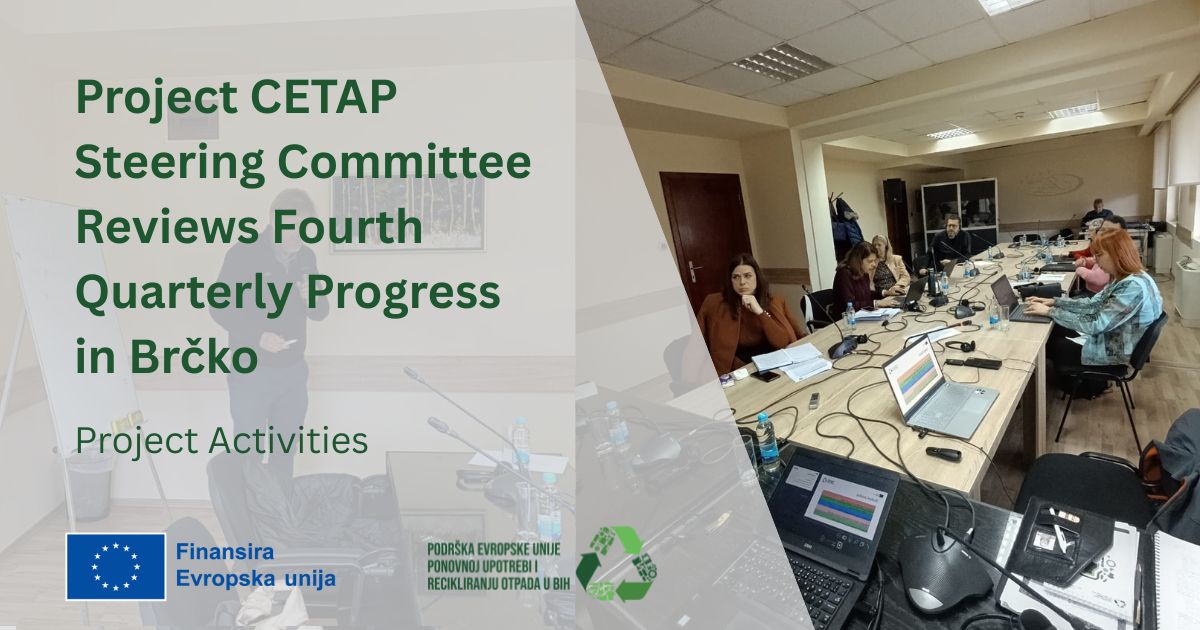
Project CETAP Steering Committee Reviews Fourth Quarterly Progress in Brčko
Project CETAP held its fifth Project Steering Committee (PSC) meeting on 9 December 2025 at Hotel Jelena in Brčko, marking another key milestone in the project’s delivery. The meeting focused on reviewing progress achieved during the fourth reporting period and agreeing priorities for the coming months ahead.
The meeting was formally opened by Mr E. Scott Crossett, the Project Team Leader, and was attended by members of the CETAP team as well as PSC members and observers, including representatives from EU institutions, state and entity ministries, and the Brčko District.
Review of Progress and Reporting Period Activities
The Steering Committee reviewed the productive progress made during the reporting period 1 September – 30 November 2025, including findings from Results-Oriented Monitoring (ROM), and discussed planned activities for 1 December 2025 – 28 February 2026.
A central item was the Draft Study Report, which provides a comprehensive analysis of policy and regulatory frameworks, market analysis, priority waste streams, Extended Producer Responsibility (EPR) schemes, technological innovation, financial and stakeholder assessments, and opportunities to treat waste as a resource. Practical examples, such as container glass, are included to illustrate market potential.
Legislative Alignment and Compliance Work
Significant progress has been made on legislative alignment with the EU waste acquis. The Project Team has reviewed the Draft Law on Waste Management of the Federation of BiH and prepared targeted recommendations to strengthen alignment with EU requirements.
Compliance Tables have been completed for all relevant administrative bodies under the Waste Framework Directive (2008/98/EC). Work is ongoing for the Packaging and Packaging Waste Regulation (EU) 2024/1781 and the WEEE Directive (2012/19/EU), with all remaining compliance work expected to be finalised in the first half of 2026.
Strategic Planning and Local-Level Engagement
A draft content outline has been developed for the Strategic Planning Guideline and Waste Management Plans. As part of this work, workshops with municipalities in Republika Srpska have commenced and work is progressing with 17 exemplar municipalities in total under the programme running through June 2026.
In the Federation of Bosnia and Herzegovina, meetings have been held with selected exemplar cantons, which have submitted formal requests for technical assistance. These cantons are at varying stages of readiness: some require only a review of existing plans, others need updates aligned with planned investments or feasibility studies, while some will require full waste management plans developed from the ground up.
Platforms for Cooperation and Waste Commerce
The Project Steering Committee reviewed progress on the development of both the multi-stakeholder platform and the waste exchange platform.
Meetings have been held with the Chambers of Commerce in the Federation of BiH, Republika Srpska, and Brčko District. While the FBiH and RS chambers already operate suitable digital platforms, the Brčko District chamber will require minor upgrades to meet security standards—support that will be provided by the project. Long-term sustainability was emphasised, with chambers expected to assume responsibility for administration and membership-based financing after project completion.
For the waste exchange platform, both Entity Environment Funds have agreed to host the system within their existing waste information infrastructures, ensuring consistency with EU reporting and data requirements.
Pilot Actions and Public Awareness
During this reporting period, the project delivered three key outputs supporting pilot actions for waste recovery and recycling:
- A waste-category screening report
- A framework for selecting bankable projects
- Project fiches for identified pilot investments
The Project Team is also reviewing data on collected and treated volumes of selected waste streams in close coordination with municipalities and councils. Work continues on EPR schemes and management systems for priority waste streams, including options related to end-of-waste status, glass, and PET.
Progress was also presented on the public awareness campaign, for which the campaign strategy has now been approved. Preparations are underway for launch events scheduled for January 2026.
Mr Crossett closed the meeting by thanking all participants for their continued engagement and constructive contributions. The meeting formally concluded at 15:00.